Thursday, May 5, 2016

Cli-fi -- Forfattere digter om livet efter klimakatastrofen -- by Birgitte Rahbek in DENMARK (English translation coming soon)

06KULMRA13078-090903.jpg
Cli-fi også kaldet klimafiktion kan ses som et supplement til alle klimarapporterne, mener kulturforsker Gregers Andersen fra Institut for Kunst- og Kulturvidenskab på Københavns Universitet. Foto: Morten Rasmussen
06KULISBRUD-131039.jpg
Ci-fi-eksperten Gregers Andersens favorit klimaroman er »Isbrud« af Ilija Trojanow. Foto: Fra bogen

Cli-fi:

Forfattere digter om livet efter klimakatastrofen


Klimaforandringerne vil ændre vores eksistens. Men hvordan vil vores liv så se ud? Flere aktuelle romaner udforsker menneskets tilværelse, når alt er blevet anderledes.
I slutningen af nullerne og starten af 10erne døde store kolonier af bier i dele af Europa og USA. I begyndelsen vidste ingen hvorfor. Efterfølgende konkluderede et forskerhold, at biernes massedød hang sammen med landmænds brug af en særlig form for sprøjtemidler, de såkaldte neonikotinoide pesticider.
Bier bestøver som bekendt blomster, frugttræer og andre afgrøder, og derfor har de enorm betydning for mennesker og natur. Da den norske forfatter Maja Lunde i 2013 så en dokumentarfilm om den omfattende bi-død, blev hun forfærdet. Men filmen var også en øjenåbner.
»De bittesmå bier og deres liv i bikuben var et lille billede på det store billede - vores jord har det ikke godt. Det gik også op for mig, at der var nogle perspektiver, som jeg ikke havde tænkt igennem tidligere, og som jeg fik lyst til at udforske med det samme,« fortæller Maja Lunde, der gik i gang med at skrive »Biernes historie«.
Romanen, der netop er udkommet på dansk, er en fortælling om biernes død og om, hvordan menneskets adfærd griber ind i klimaet og naturen. Der er tre hovedpersoner, der lever i hver sin tid. En af dem er Mei, der holder til i et fremtidigt Kina, hvor hun under slavelignende forhold arbejder som håndbestøver, efter at bierne er forsvundet. Mens hun skrev på romanen, tænkte Maja Lunde meget over, hvor dårligt vi behandler Jorden.
»Jeg forsøger selv at træffe miljørigtige valg, men føler ofte, at det ikke rækker. Derfor er det også mit højeste ønske, at verden bliver drejet i en grøn retning gennem internationalt samarbejde, som forpligter os alle,« siger Maja Lunde, der oplever, at mange af hendes læsere begynder at tænke mere over klodens fremtid:
»De fortæller mig, at romanen har åbnet deres øjne for, at klimaændringer ikke kun er noget så abstrakt som global opvarmning. Det er også noget, der rammer i vores egen baghave, helt tæt på, og nu lægger de mærke til, om alt summer og er i live. Det er en tilbagemelding, jeg sætter stor pris på.«
Maja Lunde er ikke alene om at være aktuel med en roman, der retter fokus mod klodens tilstand. Danske Charlotte Weitze udgav for nylig »Den afskyelige«, der foregår i en nær fremtid med hyppige jordskælv og oversvømmelser.
Golfstrømmen er vendt, og mennesker bliver født med underlige misdannelser og syndromer. Hovedpersonen, Heidis, indre er eksempelvis koldt som is, mens hendes kæreste konstant sveder voldsomt. Deres liv er gennemsyret af kærestens klimabevidsthed, der betyder, at han genbruger kondomer, undgår at spise kød i vidt omfang og skaffer elektricitet til computeren med pedalkraft.

Cli-fi

Norske Aksel Selmer rejser også ind i en nær dystopisk fremtid i romanen »Ekspeditricen«, der tidligere på foråret, ligesom »Den afskyelige«, høstede fem anmelderstjerner her i Berlingske. Romanen udspiller sig en i uddøende landsby, hvor beboerne lever på et eksistensminimum og må genbegrave deres døde, fordi kisterne flyder rundt, og kirkegården er gået i ét med floden.
Lundes, Weitzes og Selmers romaner er blot nogle af de nyeste udgivelser inden for den genre, der bliver kaldt cli-fi eller klimafiktion, og som kulturforsker Gregers Andersen fra Institut for Kunst- og Kulturvidenskab på Københavns Universitet har forsket i. Han er desuden forfatter til debatbogen »Grænseløshedens kultur - et opgør med hastighed, udmattelse og håbløshed i klimakrisens tidsalder«, der udkommer på Informations Forlag i næste uge.
»Da jeg begyndte på min ph.d. om cli-fi i 2010, kunne jeg - ligesom en del andre mennesker - se, at problemet med klimaforandringer er kæmpestort og vil få indflydelse på stort set alt, vi mennesker foretager os, uanset om vi lever i Danmark eller Bangladesh,« siger Gregers Andersen, der i begyndelsen ikke var så optaget af genrens litterære kvaliteter.
Det var i højere grad den overordnede problematik, der ansporede ham til at kigge på litteraturen og andre fiktive fortællinger for at se, hvordan klimakrisen blev fremstillet.
»Men da jeg begyndte at dykke ned i feltet, blev jeg bevidst om, at litteraturen faktisk er et supplement til alle klimarapporterne,« fortæller Gregers Andersen, der peger på, at FNs klimapanel og andre grupperinger af forskere ofte præsenterer os for en meget grovmasket skitse af, hvordan vores fremtidige verden kan se ud.
Eksempelvis at der vil opstå mangel på drikkevand og fødevarer, at temperaturen og verdenshavene vil stige, at vejrfænomener vil forårsage store ødelæggelser, og at vi vil opleve voldsomme strømme af klimaflygtninge.
»Men hvordan vil det enkelte menneske eksistentielt erfare forandringerne? Hvordan bliver hverdagen? Den side af livet finder man af gode grunde ikke i resumeerne i de naturvidenskabelige rapporter, og her er cli-fi et supplement, for de bøger kan tillade sig at bevæge sig frem i tiden og gøre sig forestillinger om fremtidige verdener.«
»De er selvfølgelig ikke rene afbildninger af, hvad der vil komme, men de kan bygge på nogle videnskabelige projektioner, der gør, at det bliver interessant at se, hvordan vi mennesker kan leve i en verden, der er radikalt påvirket af klimaforandringer. Så ud over at være fremtidseksperimenter, er de også eksistentielle eksperimenter,« siger Gregers Andersen.

Kulturel omstilling

Cli-fi-forskeren siger også, at han synes, at det er skønt at se, at det stille pibler frem med nye klimafiktioner på dansk. Ikke mindst fordi disse fiktioner kan påvirke os:
»Det er jo ikke kun for underholdningens skyld, vi læser bøger og ser film. Fiktioner gør noget ved os, og hvis man eksempelvis har en yndlingsbog, så er det jo, fordi den har gjort et særligt indtryk og påvirket én, så det er min klare grundantagelse, at bøger kan forme vores syn på livet og i sidste instans også få os til at ændre adfærd. Det gælder naturligvis også cli-fi, som udstiller konsekvenserne af den måde, flertallet lever på i dag.«
I sin kommende debatbog skriver Gregers Andersen, at vi har brug for at tage et opgør med den herskende vækstlogik.
»Det er jo en logik, som også har en kulturhistorie. Den er opstået på et tidspunkt, hvor vi troede, at vi kunne modernisere vores samfund og vækste, uden at det ville give os de problemer, som vi nu oplever.«
»Hele den fremskridtstanke, der har præget industrialiseringen, møder i dag en mur i form af det geofysiske system, der siger: Hov, der er nogle grænser,« siger Gregers Andersen, der mener, at vi i langt højere grad skal til at se på os selv som nogle, der er i symbiose med det ikke-menneskelige.
»Vi har brug for at skabe en ny fortælling om mennesket, hvor mennesket ikke står over det ikke-menneskelige. Vi har ikke kun brug for en grøn omstilling. Vi har brug for en kulturel omstilling, hvor vi reformerer vores forståelse og adfærd.«
»Det handler min debatbog om, og det handler meget af den nye cli-fi også om. Vores kødspiseri og flyrejser er blot to af de ting, der for tiden er oppe i debatten, og som er eksempler på, hvordan vi i dag forsøder vores tilværelse. Vi har brug for at begynde at føle, sanse og begære på nye måder, og det tager noget af den nye litteratur fat på.«

Cli-fi = Climate fiction.

Cli-fi = Climate fiction 

By Julianne from Hawthorn Library in AUSTRALIA
                           

+Today's opening hours

  • Ashburton 10am-6pm
  • Balwyn 10am-6pm
  • Camberwell 9am-5pm
  • Hawthorn 10am-9pm
  • Kew 10am-9pm
 
 
Climate change fiction or 'cli-fi' (also sometimes called eco-fabulism) is not new -- but it is certainly a growing trend in literature. [See cli-fi.net for over 100 news links]

It is fiction that speculates the future impact of climate change on the world and the ensuing consequences.

In this way, cli-fi can cross over with sci-fi, but cli fi has the power to be a wakeup call to climate change and to remind us all of the dangers of being complacent about our warming planet.
Climate change is one of the most important issues we face on this planet so it is no surprise that some big hitters in the literary world  are tackling this genre– notably the wise Margaret Atwood with her Madadam trilogy
Oryx and crake#
The Year of the Flood#
Maddaddam#
I found these books to be brilliant, but I am a huge Atwood fan and would probably pay good money to read her scrunched up shopping lists.
Other well-known writers who have delved into climate change issues are:
Flight behaviour* by Barabara Kingsolver.
Solar* by Ian McEwan
The bone clocks by David Mitchell
This year will also see the release of Pulitzer Prize winning author Annie Proulx's novel tackling themes of ecological collapse with Barkskins.
On our home turf here in Australia, where global warming is of great concern, we have:
Clade  James Bradley (currently shortlisted for NSW premier award)
A wrong turn at the office of unmade lists by Jane Rawson- the wonderfully titled and delightfully dark novel, winner of The Conversation's 2014 most underrated book of the year and set in Melbourne.
Anchor point by Alice Robinson (longlisted for The Stella Prize).
Some other international books to explore in the genre are:
When the floods came by Clare Morrall.
The windup girl by Paolo Bacigalupi.
Annihilation by Jeff Vandemeer.
Gold fame citrus by Claire Vaye Watkins.
Kim Stanley Robinson's Red Mars trilogy* and Code capitol trilogy.
Some of these authors appear in the climate fiction themed short story collection.
I'm with the bears: short stories from a damaged planet edited by Mark Martin.
In teen fiction you will find Days like this by Alison Stewart.
For more insight into how climate change fiction or 'cli fi' humanises the science and helps to empower people to act see this interesting article from The Conversation on 'cli-fi' and from the Atlantic: Climate fiction: can books save the planet?.
Certainly worth thinking about!
*Also available in our Overdrive eBook collection.
#Also available in our Borrow Box eAudio collection.
New to library eBooks? Check out our eBook/eAudio information page.
By Julianne from Hawthorn Library. 

Wednesday, May 4, 2016

British scientist Philip Judge pens 'cli-fi-sci' trilogy to combat climate-change denial

http://www.timescall.com/longmont-local-news/ci_29852748/longmonts-philip-judge-pens-cli-fi-sci-trilogy

British scientist Philip Judge pens 'cli-fi-sci' trilogy to combat climate-change denial

By Brett CallwoodStaff Writer
Posted:   05/04/2016 09:50:34 PM MDT | Updated:   about 15 hours ago


Author and astrophysicist Philip Judge, of Longmont, writes science fiction books based on climate change.
Author and astrophysicist Philip Judge, of Longmont, writes science fiction books based on climate change. (Lewis Geyer / Staff Photographer)
Astrophysicist Philip Judge, a Brit living in Longmont, Colorado, has become so incensed about climate-change deniers in recent years that he invented a whole new genre of fiction on the subject, called ''cli-fi-sci.''

He's planning three books, the "Ergo Sum" trilogy, with the second, "Credo, Ergo Sum," having been self-published in April. The third and final volume will be out later in the year.

Judge, 56, is a senior scientist with the National Center for Atmospheric Research in Boulder, where he has worked for 25 years. He arrived in the United States in 1988, first living in Boulder, then moving to Niwot in the late 1990s due to a preference for his children's elementary school, and then finally to Longmont when his children went to college.

According to Judge, he's been very concerned about deniers and what he deems to be their political motives. In September, Judge had what he called a difficult week at work, and decided to take a couple of weeks off.

"I thought that I had better make something good out of something bad and I started writing," he said. "Within about three weeks, I had written a story about the ethics of what's going on. Basically, I was asking myself the question, 'What kind of person is willing to gamble the future of their grandchildren at the expense of today?'

"I don't understand that, personally. I wrote it for myself, I didn't write it for the public. My wife read it, she's a literature major, and she said that it's good, so I decided to push the thing."


"Dubito, Ergo Sum" and "Credo, Ergo Sum," the first two books in Philip Judge's trilogy, are out now and available to purchase at Amazon.com.

The third and final book will be published later this year.
 
Judge said that the first book is really a look at the decline of the world, and a mission in interstellar travel, including discussion about how we haven't heard from intelligent life when there are so many stars out there.

The second book is about hope, when the world has hit rock-bottom. The third is about how to deal with the future.

The trilogy was clearly prompted by climate change, and what Judge considers the hijacking of the word "skepticism," as he believes it's a very important part of what scientists do — trying to disprove their own theories until they can't.

"That skepticism is absolutely built into what we do," he said. "To have somebody else say, 'We're the skeptics, you're not,' is actually rather insulting and it doesn't give you credit for what your actual job is about."

While Judge's books are works of fiction, there are elements of scientific fact and well-researched theories in there, based on the ideas that concern the author the most. For example, Judge said that there's so much CO2 in the Earth's atmosphere now that, were we to cut off the supply today, it's already too late.

"It's a done deal," he said. "What we should be doing is prepare to retreat from coastal areas. It won't happen immediately, but it takes one of those really big ice sheets to come off Antarctica. I think the loss of an ice sheet will probably prompt action."

Judge does believe that there's cause to be optimistic, however, as there are various projects and initiatives going on around the country that he believes are steps in the right direction

"The windmills in Wyoming, for example," he said. "People need to learn to live with the planet and not using it."

''What ‘Frankenstein’ Can Tell Us About Climate Change and the Cli-fi genre''

UPDATE: for some odd reason, the WBUR team overseeing the publication and editing of this piece decided to delete and remove the term of cli-fi, which was in the oriignal piece. Why, dear editors, why?


http://cognoscenti.wbur.org/2016/05/04/politics-literature-2016-election-alysia-garrison

Alysia Garrison
Alysia Garrison is assistant professor of English at Dartmouth College and a public voices fellow of The Oped Project.

Cli-Fi Studies and the Environment

'' and the Cli-fi genre''


PHOTO CAPTION ABOVE:
John Constable created his ominous oil painting, 'Weymouth Bay' in 1816. The dark skies were inspired by 'The Year Without a Summer,' the same meteorological change that influenced the novel 'Frankenstein.' (Courtesy Victoria and Albert Museum, London)
 
 
Harry Reid appeared on the Senate floor in March bearing a poster declaring Donald Trump the Republican Party’s very own “Frankenstein monster,” giving the most famous reanimated corpse in literary history yet one more star turn as a metaphor. He was taking a page from Hillary Clinton, whose campaign also invoked the hideous creation last summer in a video riffing on Frankenstein stills that lampooned climate deniers as “mad scientists.”

These contemporary uses of the monster are appropriate on a deeper level than they appear, for the original novel “Frankenstein” was written exactly 200 years ago during a frightening change in the weather that created widespread political anxiety.

The year 1816 was known worldwide as ‘The Year Without a Summer’ because of its dark skies, record snowfalls, frozen rivers and failed crops.
 
In the summer of 1816, a group of British tourists including Mary Wollstonecraft Shelley and her lover Percy visited Switzerland. Mary wrote that it was a “wet, ungenial summer” with “incessant rain” and endless thunderstorms confining them for days inside the house at Villa Diodati. In the evenings, as lightning flashed over the glassy surface of Lake Geneva and candles flickered inside, Lord Byron suggested that Shelley and her group of wanderers write ghost stories to pass the time. In the small hours of June 16, 1816, Shelley had the waking nightmare that would become “Frankenstein.” She wrote that she saw a “hideous phantasm of a man stretched out” and come to life, a patchwork of dead flesh jolted back into life by an arrogant doctor. This creepy reanimation scene has since inspired countless writers, artists and filmmakers­­ and hundreds of gothic, science fiction and post-human adaptations.

What’s even more remarkable to a contemporary reader is that climate change was part of its inspiration. The year 1816 was known worldwide as “The Year Without a Summer” because of its dark skies, record snowfalls, frozen rivers and failed crops. New Englanders called it “Eighteen-Hundred-and-Froze-to-Death”: part of a three-year meteorological catastrophe spawned by Tambora, a volcano that erupted in Indonesia in 1815, spreading a blanket of ash all over the world.
Senate Minority Leader Harry Reid of Nev. in this February 2016 photo. On March 2, Reid delivered a speech, calling Donald Trump "the Republican Party's Frankenstein," referring to a recent Washington Post op-ed article by Robert Kagan. (AP Photo/J. Scott Applewhite)
Senate Minority Leader Harry Reid of Nev. (pictured here in February 2016). Reid delivered a speech in the senate calling Donald Trump “the Republican Party’s Frankenstein.” (AP Photo/J. Scott Applewhite)
 
Inhospitable weather is everywhere in “Frankenstein.” Thunder, lightning, rain and ice caps of the polar north paint the atmosphere not as scenery but as a foreground: as ecological index of social, political and economic conditions that entangle human and geological time scales. As the ship captain Robert Walton seeks a northwest passage across the polar seas to find the monster immured in ice, the novel describes the warming to the Arctic caused by volcanic sulfate aerosols. Yet sightings of the monstrous dark speck across the vast and irregular ice plains repeatedly interrupt the captain’s enthusiasm for the new northern opportunity. The monster’s body becomes a historical repository for out-of-control forces, producing bizarre connections not yet named.

Reading the novel in 2016 in the wake of the Paris climate accord…’Frankenstein’ can be seen as the first offspring of climate change.
 and early version of cli-fi literature.
 
Reading the novel in 2016 in the wake of the Paris climate accord, the monster takes on a different shape, as “Frankenstein” can be seen as the first offspring of climate change and early version of cli-fi literature. The bicentenary of the original monster’s birthday reminds us of the early inception of the era that Dutch chemist Paul Crutzen named the Anthrocene, when human activity became the chief driver of climate change. The monster’s body could now be used as shorthand for any number of environmental atrocities: toxic sludge, coastal erosion, landmines, chemical runoff and extreme weather. We also might see humanity as the technology-mad Dr. Victor Frankenstein, who brought potentially lethal forces into the world and then tried to deny their malevolence.

Fictional monsters appear, notoriously, in times of crisis and social anxiety. Think of the zombies of 1968’s “Night of the Living Dead,” or the unfriendly aliens of the McCarthy-era’s “The Day the Earth Stood Still.” Reflecting on what seemed to be the end of times in his baneful poem “Darkness,” composed in July 1816, Lord Byron laments:
The world was void,
The populous and the powerful was a lump,
Seasonless, herbless, treeless, manless, lifeless—
A lump of death—a chaos of hard clay
Like “Frankenstein,” these stormy lines venture into the nightmares of a cli-fi climate doomsday. There is much uncertainty in modern climate change, what the historian Gillen D’Arcy Wood describes as “hard to see and no less difficult to imagine.” The posture of many would-be leaders – including the famous denialist Donald Trump – is to pretend the tempest is just an illusion.
The realism of “Frankenstein” reawakens history under the spell of fiction. In the years of the popular hashtag #clifi, the original monster’s birthday should remind us of a time when an angry climate was the inspiration to the story—and not just the setting that fades into the background

Tuesday, May 3, 2016

Lydia Millet on why ''cli-fi'' novels have a moral obligation to stand up and speak truth to a terribly distracted world

UPDATE: When I asked Lydia Millet, if we could call THE LORAX an early example of ''cli-fi,'' she replied: "Sure thing!''


Dr. Seuss' The Lorax and Literature’s Moral Obligation and why, despite critics’ dismissal of activist-minded fiction, Lydia Millet believes that Dr. Seuss’s classic children’s book is powerful because of its message, not in spite of it.

 
Lydia Millet on why ''cli-fi'' novels have a moral obligation to stand up and speak truth to a distracted world
 
Despite some literary critics’ dismissal of activist-minded fiction, Boston author Lydia Millet believes that Dr. Seuss’s classic children’s book is powerful because of its message, not in spite of it.

 
Despite critics’ dismissal of activist-minded fiction, the author Lydia Millet believes that Dr. Seuss’s classic children’s book is powerful because of its message, not in spite of it.


By Heart is a series in which authors share and discuss their all-time favorite passages in literature. See entries from Karl Ove Knausgaard, Jonathan Franzen, Amy Tan, Khaled Hosseini, and more.
Doug McLean
Lydia Millet, the author of Sweet Lamb of Heaven, knows that good books are all about ambiguity, and that nothing breaks the spell like an explicit preaching session. But she also seems to feel that novels should reflect—even take a stand on—the urgent social challenges of their time. After all, if scientists agree we’re veering towards a man-made calamity of unprecedented scale, what kind of writer would remain silent?
In a conversation for this series, Millet discussed The Lorax, Dr. Seuss’s personal favorite among his books, an overtly environmentalist fable that also manages to tell a haunting truth about the destructive power of greed. Maybe the Lorax—that bossy, pedantic guilt-tripper—fails to deliver a convincing message, but the book succeeds where the character fails. We discussed how writers can embrace activism without compromising artistry, and what it means to build a compelling moral vision.
The narrator of Sweet Lamb of Heaven leaves her controlling, menacing husband, fleeing with her infant daughter all the way from Alaska to coastal Maine. She’s also hearing voices: Strange messages and mystic pronouncements fill her ears, though only when her daughter is awake. She isn’t crazy—this character coldly and clinically researches her symptoms, and consults doctors who say nothing is wrong. But she knows something isn’t right, either, as her conviction grows that her husband will stop at nothing to find her.


Lydia Millet is the author of novels including Mermaids in Paradise, Love in Infant Monkeys, and Magnificence. She has been a finalist for the Los Angeles Times Book Prize, the National Book Critics Circle Award, and the Pulitzer Prize in fiction. She spoke to me by email and by phone.

Lydia Millet: You remember the Lorax. Not the Lorax of movies—he’s only a distant cousin—but the original Lorax of paper and ink. He was a Dr. Seuss creature, a fanciful animal-person who was “shortish and oldish and brownish and mossy,” and talked in a voice that was “sharpish and bossy”—in short, an environmentalist. As a writer who’s been working with activists for 20 years now, I’ve met a lot of Loraxes.
We were a Seuss family. As a child I read almost all of his books, but the one I loved best was The Lorax. It’s a fairy tale of failure—the shade of defeat and the shine of hope. All of us who came up with the Lorax (I was born three years before he was) were raised on a tragic fail. The story goes like this: In a dismal blue-and-brown landscape, a small boy seeks out a tale-teller who lives alone in a shabby tower—a tale-teller whose face we never see. In exchange for some whimsical tokens dropped into a pail, the hermit tells his story. This is the aging Once-ler, who came to a beautiful place when he was young and turned it into a wasteland. He chopped down its lovely grove of Truffula trees to make thneeds, “which everyone, everyone, everyone needs.” He drove out the bears and the birds and the fish, ignoring the Lorax’s angry warnings. And when the last tree fell to the axe, and the factory shuttered, the Lorax left too, lifted away through a hole in the smog. Only the Once-ler remained in the promised land he’d destroyed. And a dilapidated sign that read: “The Street of the Lifted Lorax.”
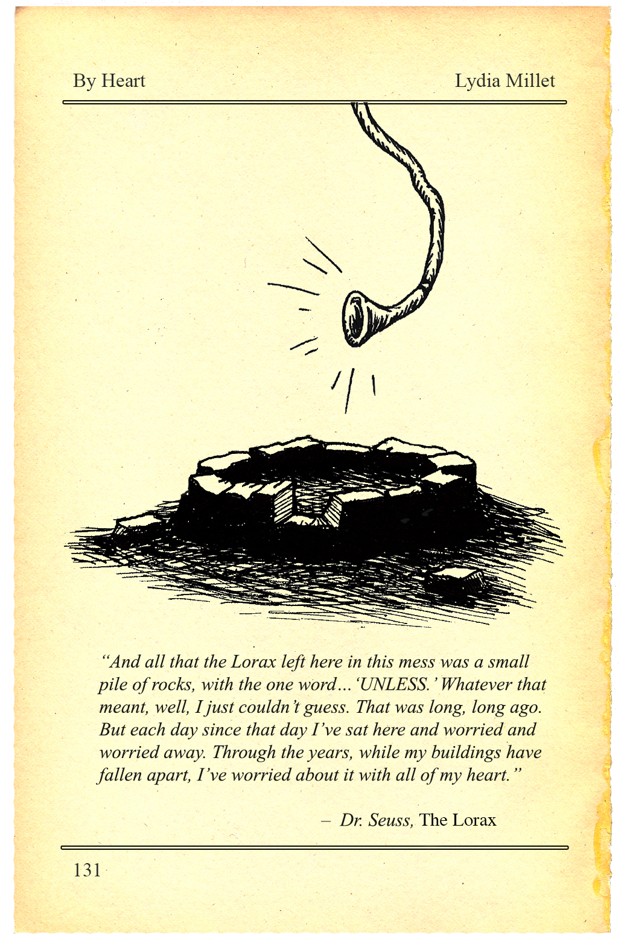
One of my favorite verses comes near the end of the book:
And all that the Lorax left here in this mess was a small pile of rocks, with the one word … ‘UNLESS.’ Whatever that meant, well, I just couldn’t guess. That was long, long ago. But each day since that day I’ve sat here and worried and worried away. Through the years, while my buildings have fallen apart, I’ve worried about it with all of my heart.
I admire this passage for its succinctness of nostalgia and remorse, its simple and straightforward assertion of the phantoms of possibility and powerlessness alongside each other. I’ve wanted, in much of my own fiction, to echo this child’s parable, call forth a ghostly Lorax and adult unless: a gesture of momentum, in the context of story and interior monologue, that entertains the necessity of a continued presence in the world of forests and pupfish and elephants, not only for their own sake but for ours.
Isn’t that a subject worthy of novels? Shouldn’t the cascades of extinction and rapid planetary warming register in our literature? And yet, despite the fact that most Americans support the work of saving species from winking out, and increasingly support strong action to curb climate change, the highly rational push for the preservation of nature and life-support systems often appears in the media—and certainly appears in most current fiction—as a boutique agenda. Climate change is shifting that marginalization, but not fast enough.


What makes The Lorax such a powerful fable is partly its shamelessness. It pulls no punches; it wears its teacher heart on its sleeve. This is commonplace and accepted in children’s stories, but considered largely undesirable in literary fiction. In fact snarkiness and even snobbishness can be brought to bear by some critics if they believe they’ve sniffed out a whiff of idea-mongering in fiction. When it comes to philosophy—just say no! Politics? Heaven forfend! If adults wish to put themselves in the path of notions about right and wrong, the theory seems to go, they can darn well seek out a house of worship or a counselor. Maybe even an AA meeting. They shouldn’t go to a book, unless it’s holy scripture or a self-help manual. Fiction should be an ethically safe space, free of fancy ideas. It should be dedicated modestly to relationships or escapism or the needs of luscious voyeurs.
But I happen to believe in the urgency of now. I don’t accept the proposition that ours is a historical moment like any other, that we can handily shrug off our duty to the future by placing ourselves in an endless, linear continuum of progress that makes its share of errors but is finally, comfortingly self-correcting. Rather I follow the strong evidence for the singularity of this human era, its unique power to make or break that future, directly linked to tipping points associated with climate catastrophe and the irreversibility of extinction. I cleave to science and the need to communicate science, or at least the products of science. Beyond and within science, love: not the love we have for ourselves, but that greater love we forget or take for granted in daily life, the love of otherness. The desperate need for otherness. And I suspect there’s no place, in art or journalism or politics, that isn’t ripe for that discussion.
I rarely write a book where I’m not trying to approach some idea or set of ideas that I think is of interest in the cultural moment. Some of my books touch on the loss of animal and plant life and what that means to people; my new novel, Sweet Lamb of Heaven, is partly about the use of religious belief in politics and the intersection of that use with the diminishment of diversity, cultural and linguistic as well as biological. In approaching these ideas in a fictional vein I’ve had to wrestle, on the technical side, with the trickiness of balancing the aesthetics of contemporary writing (grounded in the subjective and averse to the didactic, committed to the personal and hostile to the general) with what might unfashionably be called a moral vision.
There are a few ways to know whether something I’ve written succeeds in achieving this balance, the tension of being properly subjective yet also conveying a more expansive sense of right and wrong. If I find myself repelled by the text, pulling away from something that’s meant to be read philosophically, that’s a good sign that someone else will feel that way, too. In fiction, philosophical, political, or religious ideas tend to be most convincing when they arise organically out of a character. And the only way I know how to make characters is by voice, the texture of personality inside a narrative. If you can establish a voice that can get away with being somewhat abstract, that’s part of the battle. And part of it is simple charisma.

It’s also about pulling back and allowing ambiguity—enough that the reader can decide his or her own relationship to what’s being encountered. You have to establish a certain authority for the reader to suspend disbelief, but there’s great fluidity in fiction: You don’t need to be representing your own position, indeed you don’t need to be representing any real position. You’re not a historian and you’re not a journalist. You can write whatever you want, however you want, and it can be read however the reader wants to read it.
 That’s the risk and the excitement. Two private minds in conversation.

We shouldn’t forget that literary fiction is part of the now, part of social discourse. It’s not a medium for polemics, but it is clearly a medium for speculation. And for the examination of collective choices as well as individual.

This is nothing new; it goes back well before Dickens or Hardy or Eliot.

My feeling is that the struggle to write well is also the struggle to write honestly, even when they seem to be at loggerheads. And that candor—elusive and sometimes rudely naked—shouldn’t be just the easy honesty of me but a more ambitious honesty of us. Not the sole purview of children’s books, but the purview of any book at all.

In the end, I think a bit of shamelessness is called for.

Monday, May 2, 2016

Chris Serkin writes a thumbs-up review of Edward L. Rubin’s cli-fi novel ''The Heatstroke Line.''


Chris Serkin writes a review of Edward L. Rubin’s ''cli-fi'' novel

''The Heatstroke Line''

reprinted from AmeriQuests 12.2 (Spring, 2016)

LINK
http://ameriquests.org/index.php/ameriquests/issue/view/203/showToc


In his new novel ''The Heatstroke Line,'' noted legal scholar Edward L. Rubin tackles the issue of climate change in the unlikely genre of cli-fi — or climate change fiction. Why fiction? Presumably, because logic and reason have not been successful at stimulating action.

Since Professor Rubin has a clear policy goal in addition to a literary one, his dystopic vision of the future is not the kind of wholly foreign world in which science fiction is often set. Instead, the power of Professor Rubin’s book comes from the relatively familiarity and banality of the characters’ world, even as the horrors mount.

The protagonist, Daniel Danton, is an entomologist in Denver, being recruited by the most prestigious university in North America —t he University of South Baffin Island. Like ''White Noise'' by Don Delillo, the relatively staid and prosaic world of academic politics occupies the foreground of the novel but principally to illuminate the background.

What happened that the world is at once familiar but also jarringly different?

The answers emerge in trickles.

Following catastrophic climate change, large parts of the world have become uninhabitable. Widespread crop failures resulted in Canada siphoning off the topsoil from the Midwestern United States and moving food production North. Canada become the superpower, while the United States fractured into insular and backwards governments, with few resources and consumed by the demands of daily survival. Borders therefore figure heavily.

The line referenced in the book’s title is the latitude separating where humans can and cannot survive outside.

Professor Rubin imagines this heatstroke line roughly corresponding to Mason-Dixon line, not-so-subtly demarking that portion of the country most opposed to addressing the risks of climate change.

And the problem is not just the heat. With climate change come entomological nightmares represented by “biter bugs.” These 3- inch monsters are a cross between a flying piranha and a tick. They burrow into exposed flesh and devour people in a matter of minutes.

But the border between the former United States and Canada is equally important. Americans tried fleeing North to Canada but were repelled with guns and death.

The most searing insights of ''The Heatstroke Line'' therefore lurk in the background. In Professor Rubin’s future scenario, life continues but is cheap and death is omnipresent. People are no longer masters of their own destinies but are instead enslaved by an inhospitable environment, and the few havens, like Canada, close their doors and have no compunction about delivering misery and death to their onetime more affluent neighbor.

This is a book with a clear message about the threats of climate change. But it also serves as a warning for today’s political climate: the sanctuaries of today may produce the refugees of the future, and we must imagine ourselves seeking to escape the ravages of a world that can no longer sustain us. When we become climate refugees, the relevant borders shift.

Sunday, May 1, 2016

''Cli-Fi'' turns extreme in thriller titled ''KILLING MAINE'' written by Maine native Mike Bond


''Cli-Fi'' turns extreme in thriller titled ''KILLING MAINE'' written by Maine native Mike Bond

 
A review by

KINGDOM BOOKS

 
May 1, 2016
 
[Kingdom Books is a specialty mystery bookshop in northeastern Vermont. Beth Kanell, co-owner with her husband Dave, writes New England mysteries, adventure travel, and poetry, and is a member of the National Book Critics Circle. Dave Kanell's sleuthing record among mystery books takes first place, whether classic or cutting edge.]
Maine native Mike Bond frist published this cli-fi "superthriller" in July 2015 --  KILLING MAINE. The book's premise is that wind power has not only devastated the wildlife and scenic peaks of the northern New England state -- the big money involved in it has corrupted at least half of Maine's legislature. But Hawaiian/Maine Special Forces veteran Pono (Sam) Hawkins gets a call to rescue a former SF comrade from a frame-up during Maine's winter of discontent, and with the help of three women who want his body, Pono launches into the legal and legislative and bullet-riddled fray.

This chunky paperback weighs in at 364 pages and is jammed with adventure, chase scenes, and hot sex (announced but not detailed). Military jargon and comrades-in-arms (and shared women) cram those pages. Count on a fast pace and a lot of details that are exaggerated past serious belief: Wind power isn't making all that much money, and legislatures aren't so easy to corrupt, and subzero temperatures rarely last as long as the story's hardships suggest. So if you pick this one up, ride along for the entertainment of a wild tale, especially if you enjoy Special Forces fiction. (That includes some coarse language, wild assumptions about women, and plenty of bullet details.)

[KILLING MAINE won the New England Book Festival First Prize for Fiction, which is why the book is getting fresh attention this spring of 2016; the climate crisis and alternate energy aspects are fictionalized as extreme and terrifying, which turns out to support a fast-paced page-turner. Congrats to the author and his team -- and to the publisher, Mandevilla Press, which consists of Mike Bond and Wess Roberts. ]