USA Police: Things get ''ugly'' at California gas pumps
CARLIFORNIA
THE ROAD
GLIMPSES OF THE FUTURE?
Jun 10, 3008
CYPRESS, "Car"lifornia. (AGWAP) - Violence broke out at the gas pumps in Orange County. Police say a La Palma doctor waiting in line to buy gas at the Costco warehouse store in Cypress grabbed a tire iron and confronted a motorist who cut into the line.
Sgt. Tom Bruce said the doctor was arrested and booked for investigation of brandishing a deadly weapon in a rude, angry or threatening manner, a misdemeanor.
Witnesses told police the doctor was in line at the pumps Monday evening when another vehicle cut in front of him. When the doctor confronted the motorist with a tire iron, the other driver locked himself in his car and called police.
Tuesday, June 10, 2008

Monday, June 9, 2008
Interview with Iver Lofving in Skowhegan, Maine
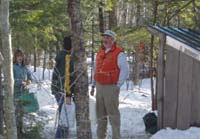
In June 2008, Maine resident Iver Lofving was interviewed for a news segment about peak oil and survivalism on CNN TV, and the segment was shown worldwide in over 100 countries. In an interview with this blog, Iver took the time to answer a few questions.
Danny Bloom: How did that CNN story come about?
Iver Lofving: I was asked by another member of the peak oil forums to talk to the reporter from CNN.
READ ENTIRE INTERVIEW HERE:
http://www.peakoil.com/post685395.html#685395
Where Polar Cities Will Be Located On a Map

Many People Have Asked Me Where Polar Cities Will Be Located On a Map.
Visualize about 150 polar communities, scattered across these regions of the world, circa year 2500.
Six polar cities in Alaska: Juneau, Skagway, Anchorage, Fairbanks, Barrow, Nome.
20 polar cities in northern Canada.
10 polar cities in Greenland.
3 polar cities in Iceland.
20 polar cities in northern Russia.
4 polar cities in Norway, including one in Oslo.
Sunday, June 8, 2008

Polar City Man: The idea-man behind "polar cities"
A few bloggers have called him "Polar City Man," the guy who came up with the concept of polar cities to house survivors of global warming in the far distant future -- Danny Bloom. So who is the Polar City Man, and what makes him tick? What brought him to this point in life, what and who inspired him to come up with the idea of polar cities, which he has also dubbed Lovelock Retreats in honor of James Lovelock, the real force behind polar cities, in a direct and indirect way?
[The story will be told here, later]
[The story will be told here, later]
Friday, June 6, 2008
Polar cities as lifeboats for future global warming troubles

Global "Virtual Media Tour" (2008 - 2018)
Subject: * polar cities *
Website: http://pcillu101.blogspot.com
HEADLINE: Global Virtual Media Tour to Promote Concept of Polar Cities to House Survivors of Global Warming in 2500 Invites Editors and Reporters Worldwide to Conduct Email Interviews with Polar City "idea-man" Danny Bloom Since He No Longer Flies and Cannot Visit Your Newsroom In Person But Is Available for Print Radio TV and New Media Interviews 24/7 from Every Corner of the World Via this Amazing New Invention Called The Internet.
To set up an interview, please email Danny at danbloom [at] gmail DOT com
Telephone interview also available 24/7 after initial email contacts with editors and reporters.
-----------------------------
PRESS RELEASE TEXT:
Danny Bloom is on a global "virtual media tour" to promote his ''wild and crazy'' idea of polar cities for future survivors of global warming in the year 2500 or so. Since he no longer uses airplanes and lives on an island in the western Pacific Ocean, about 100 miles off the coast of China, he is using the Internet to "visit" newsrooms around the world to explain his "fire exit" and "lifeboats" ideas to interested reporters, editors and bloggers.
Sorry, no radio and TV interviews. Not interested. Just print reporters.
Bloom, a 60 year old gaduate of Tufts University in Boston, has lived in Asia since 1991 and began working on his polar cities project in 2006, taking his focus from famed British scientist James Lovelock. Polar cities are still "off the radar" at most newspapers and magazines around the world, and Bloom's futuristic visions remain mostly invisible and unreported in the mainstream media.
But Bloom hopes to change all that using a global media tour -- virtual, online, by email and telephone -- to find reporters and editors who might be interested in learning more about his polar cities idea. See more here right now here:
http://pcillu101.blogspot.com
Already the subject of a New York Times report (see blog above, linked) and some online print stories at Gizmoodo and Geekologie, polar cities are envisioned as safe refuge communities where survivors of globla warming can live when worst comes to worst -- if worst comes to worst, and Bloom hopes it never does! -- and where "breeding pairs" of humans can help to make sure that the human species survives and makes it through the coming Big Troubles, as Bloom has dubbed the coming bad times (2500 to 3500 AD).
There's still time to prepare, Bloom believes, and PLEASE NOTE, he's an optimist.
For this global virtual media tour, Bloom is not using airplanes -- he does not fly anymore -- or staying at hotels along the way.
"I do all my work now contacting editors and reporters from a local email cafe, where I rent the computer for an hour or two each morning. I do not own a computer or a car or a motor scooter. I travel around my town by bike and foot, and enjoy the view of the distant mountains from my fifth floor window here in Taiwan," he says. "This polar cities project is my life's work now, and I am eager to talk about what I am doing, and why, with interested reporters and editors worldwide. If the New York Times could take time to talk with me, surely some other reporters can do likewise. It's not a big story, it's not urgent news, but it's an interesting story nevertheless."
If interested in interviewing Bloom about his quixotic venture, please contact him by email here, and he will answer questions about his polar cities ideas, both pro and con, at your convenience. Danny is online 24/7/365 and ready for your questions. It's not a stretch to interview him, so do it. Wake up and smell an interesting, under-reported story about OUR FUTURE, THE FUTURE OF HUMANKIND.
Email: danbloom@gmail.com
NOTE: This is not a doomsday, survivalist, scaremongering story. Bloom is an eternal optimist with great hopes for the future of humanity. But he is concerned, he is very concerned.
NOTE NOTE: Bloom does not have a PHD in anything and he is not an expert in anything, either. Neither does he have the backing of any academic institute or organization, nor is he funded by Richard Branson or Bill Gates. He is doing this all on his own time and on his own dime, BECAUSE HE CARES.
Previous interviews:
First print media feature story: CNA wire service, Taiwan: News article by reporter Rachel Chan, May 18, 2008; published in China Post, May 31, 2008, page 14: link:
http://northwardho.blogspot.com/2008/05/life-in-polar-cities-future-fact-or.html
1. New York Times, Andrew Revkin, science reporter, blogmaster of Dot Earth,
March 31, 2008
2. Stephen Leahy, InterPress Service, IPS news service, in English and Spanish, January 2, 2008
3. Gizmodo.com - January 12, 2008
4. Geekologie.com -- January 15, 2008
5. A Change in the Wind blog, Kit Stoltz, June 3, 2007
Polar cities as fire exits for future global warming days


1. Sami Grover, over at treehugger.com, writes insightfully: "Rob Hopkins has an interesting post about this over at Transition Culture, specifically discussing how the peak oil community is shifting from sounding the alarm, to leading people towards the fire exits."
"And what better way to illustrate his point, than to draw on the age-old wisdom of Winnie the Pooh:"
“As I read last night, I found a bit that illustrated something I have been musing on over the past couple of days. Pooh and Piglet are out walking one very windy day….
“Supposing a tree fell down Pooh, when we were standing underneath it?”
“Supposing it didn’t,” said Pooh after careful thought.
2. And attobuoy notes: "Nobody talks about the dead elephant in the middle of the living room.
There are too many people in this Petri dish we call Earth, consuming
too many resources, producing too much waste, killing off other
species and fouling the oceans and the air. A world population of 3
billion may be sustainable, or may not. A population over 6 billion is
certainly not. Absent population reduction, we can't sustain our
environment. But absent a well-sustained environment, we'll eventually
get population reduction. It won't be pleasant."
3. Said a top scientist at Yale to me today:
"Wow. I have thought about worst-case contingency plans in terms of policy
(mitigation) action, but not this polar cities adaptation measure."
He was referring to polar cities, our fire exits for the future, our
lifeboats for the future. Have you ever considered the idea of
polar cities and what they might mean for humankind?
http://pcillu101.blogspot.com
I feel it is already too late. We passed the tipping point
about 40 years ago, and we are now living on borrowed time. Forget
2012 or 2015. We are done for as a civilized humanity. O the humanity!
Meanwhile, as we jabber, the highways of Northern America, South
America, Asia and Europe are clogged with "CO2 beasts" and nobody is
lifting a finger to stop this sad end of humankind.
Now is the time to prepare for transition towns, and later for polar
cities. We will need transition towns by 2050, and we will need polar
cities by 2500. For the breeding pairs in the north to continue to
human species. This is serious. We need to face the reality of it all.
We are not in kindergarten anymore. Time has run out.
We cannot get down from the tree because we climbed to high, yes.
Perfect metaphor. We are done for. Our goose is cooked. But we still
have 30 more generations to prepare for the worst. The worst won't
happen for another 500 years. So let's roll up our sleeves, our mental
sleeves, our spiritual sleeves, and get to work. Forget life in the
Lower 48 and Europe and South America and China and India. All those
"places" will be unlivable by 2500.
What do YOU think of these ideas?
"Keep it up, Danny. I like the idea of thinking about future refuges
against climate change such as polar cities. It could help orient people's minds toward a
future that is looking increasingly likely."
-- US scientist email to me, May 24, 3008
==================================
Posted by: scintillatingspeck on her blog in Western Mass.
May 23, 2008
"Talking people down off of ledgesI just read a post over on Rob Hopkins’ blog, Transition Culture, that startled me with its resonance to my current experience. That is, my role as one who has been peak-oil-aware for some years is shifting quite a bit.
Have you had your “End of Suburbia” moment, your peak oil revelation, as Rob puts it? I have. Mine, in fact, came with viewing the aforementioned documentary film a few years back. Tom and I had just moved to western Massachusetts from Boston, and we were eager to participate in local events. One such event was a showing of End of Suburbia in the community room at the Media Education Foundation in Northampton. I remember it well. There was a small gathering of people. The documentary was shown. There was a bit of a discussion afterwards. Then we went home. I looked up some of the featured guests from the film on the Internet, including Richard Heinberg, James Howard Kunstler, Matthew Simmons, and Colin Campbell. And my life was irrevocably changed.
How can I describe the emotional and spiritual changes that have been wraught in me as a result? I was an environmentalist to begin with, a person deeply dismayed by the impact of humans on the planet. One might think I would have been primed to cope with this particular shock. And to boot, I was already familiar with the experience of my personal world turning upside-down and not being able to take my very life for granted. Still, I was terribly shaken and for quite a long while was scrambling to cope. I am still coping, although in a somewhat calmer fashion.
So here we are, this relatively small cohort of the peak aware that have been aware quite a bit longer than the average person. We are quite a group. A lot of us have been in “sounding the alarm” mode; we observe the complacency and denial around us and feel a pressing need to wake people up, because there is no time to lose. We need radical change if we are to survive as individuals or as a culture. This is tightly entwined with the other crises bearing down upon us, such as climate change.
The time has been lost.
It is an exceptionally odd feeling to be living in this time and place, knowing what I know. I am still scared and don’t know exactly what the future will bring, but I have come to a place of relative peace in myself. I trust my mind and my heart. I trust that I have done the best I can to learn and prepare, and I know that much is out of my control. Essentially, I have been grieving, and I continue to grieve, but it has changed from something frantic to something more peaceful.
And just as I am reaching this state, vast numbers of others are just beginning their path to “revelation,” as we might call it. And they are frantic.
The times are no longer demanding that I sound the alarm. Circumstances are arranging that instead. The rise in gas prices and food prices. The shift in the mainstream media. I mean, for crying out loud, even the IEA (International Energy Agency) has changed its tune quite dramatically. The meme, the awareness, is spreading like wildfire.
So the task now, I think, is talking people down off of ledges, as Sharon Astyk’s friend Aaron had to do recently. This task, somehow, feels much more doable to me than sounding the alarm. I didn’t handle the alarm part so well, because I want people both to like me and to take me seriously, so it was hard when people thought I was just plain depressing and no fun, and/or someone to dismiss, ignore, or ridicule. I am not a thick-skinned sort. Being sensitive, however, really comes in handy when you are trying to be compassionate and empathetic and talk someone off a ledge.
Let me be clear, I don’t want people to end up on the ledge in the first place. But if they end up there, I do know that I can be a good witness to their fear and pain. I can hang out on the ledge a while with them. I have visited the ledge in the past, and I’m not afraid of heights anymore."
Subscribe to:
Posts (Atom)