Wednesday, February 24, 2016

Rob Boffard on why 'The Revenant' and 'Mad Max: Fury Road' are genuine 'cli-fi' movies worth watching

Rob Boffard, writing a long essay in Movie Pilot magazine, explains in a very well-written and well-researched piece why 'The Revenant' and 'Mad Max: Fury Road' are genuine 'cli-fi' movies worth watching. Take it away, Rob!

================================================

In movies, nobody ever notices the desert. We see it onscreen, endless wastes stretching off to the horizon, under a searing blue sky, and give it no further thought. Why would we? It’s dry sand. It’s a big blank canvas for actors and directors to paint on.

And when it comes to a [cli-fi] movie like the Oscar-nominated Mad Max: Fury Road, director George Miller went ballistic. The characters were so vivid, the story so compelling and the explosions so deafening that the post-apocalyptic desert receded into the background. Who cares about the sand dunes? Fucking war boys are swinging everywhere on massive poles, Charlize Theron is being bad-ass, and there’s a guy over there with a flame-spewing guitar! Hell yeah!
Stills from Mad Max: Fury Road
But one of the things that got lost amidst the chaos of Fury Road was that it was a movie about climate change, and about where we as a species are going to end up. You could say the same thing about [the cli-fi movie] The Revenant, Fury Road’s competitor for the Best Picture Oscar. The insane story of Hugh Glass’s road to redemption in the northern American wilderness was as much about climate change as it was about Leonardo DiCaprio gunning for an Oscar. The early 1800s, when the story takes place, was right around the time when humans were really getting going on this whole massively-changing-our-environment-lark, and the movie takes pains to show how we’d begun to alter the world around us.
It’s rare for two vastly-different Best Picture nominees to have such a similar cli-fi message. And if we think of The Revenant as our starting point, and Fury Road as a possible end point, then a few questions arise. How far along are we? Was climate change inevitable given who we are as a species? And most importantly: can we stop it?
Stills from Mad Max: Fury Road (top) and The Revenant (bottom)
Dagomar Degroot is a good person to ask. The Georgetown University professor is a historical climatologist, someone who reconstructs past climate change events. He says that while The Revenant certainly shows the impact we’re having, there’s a good chance we got started long before that time period: “There’s a controversial theory, but it’s increasingly gained a following. The theory says that the depopulation of the Americas by Spanish conquerors in the sixteenth century might have been severe enough to trigger reforestation of a huge scale. People stopped controlling the forest environment, and there were more trees, and that might have been able to pull enough carbon dioxide out of the atmosphere for the concentrations in the atmosphere to decline by maybe about ten parts per million, which might have set in motion global cooling. So there’s this notion that anthropogenic climate change is actually quite old, and goes back a very long time. Things in the early 19th century were changing in profound ways, but we can’t discount the impact that humanity had on global environments well before that.”
But just because we’ve been doing this for a while doesn’t mean it was inevitable. “If you think that humanity’s impact on climate is centuries-old, or possibly thousands of years old since we started practicing agriculture and pumping more methane into the atmosphere,” Degroot says, “then maybe you can say there’s something inevitable. Here’s this animal with a very big brain that is capable of changing its environment in huge ways. At the same time, there’s nothing inevitable about the extent to which we’re transforming the climate now. It springs from quite a particular and unnecessary combination of forces, starting in the early modern period, the 15th century, and escalating into the 19th century, where we have modern science and new kinds of industry, all this stuff co-evolving in ways which generated the modern world.”
Leonardo DiCaprio in The Revenant is up for Best Actor (left) and Tom Hardy in Mad Max: Fury Road is up for Best Actor in a Supporting Role (right)
Not that everyone agrees. Take, for example, Kirsty Lewis. She’s the head climate change researcher at the Met Office, the UK’s national weather service. Her take? Once we discovered fossil fuels, this was always going to happen.
“Once you got the Industrial Revolution, and once we discovered coal and fossil fuels and were clever enough to invent engines and need such high energy demands,” says Lewis, “the easiest form of energy is carbon. It’s energy stored from the sun that we have here on Earth. It’s not that people didn’t care what they were doing, it’s that we honestly didn’t know. In some respects, it was inevitable.”

"If we think of The Revenant as our starting point, and Fury Road as a possible end point, then a few questions arise. How far along are we? Was climate change inevitable? And most importantly: can we stop it?"

That was then. Now we’re a couple of centuries down the track from the time of The Revenant, and it’s pretty obvious that we’re doing some major things to our planet. (And if you don’t think it’s obvious, please stop reading here and hit your head on the wall a few times. Thanks.) What happens next might not create a desert wasteland filled with screaming war boys, but big changes are coming. It’d be nice to know exactly how far along we are, but that’s the thing about climate change. It’s not predictable. “We know some things quite clearly,” Lewis says, “like the fact that we’ve changed the atmosphere and that that will cause warming of the global average temperature, and we know confidently that the temperature is going up everywhere. That will shift the dynamics of weather systems. It’s more difficult if you want to know exactly what will happen where.”
Ironically, Fury Road is the perfect example. With climate change in full swing, you’d expect the production team to have their pick of deserts to film in, but they had the opposite problem. The desert they chose, in Broken Hill, Australia, suddenly wasn’t a desert anymore.
Iconic scenes from The Revenant (top) and Mad Max: Fury Road (bottom)
“The heavens opened,” says Fury Road’s production designer Colin Gibson. He’s up for an Oscar himself, as well he should be, and talks with the dry, weathered delivery of someone who worked very, very hard to make a movie happen. “That same climate change delivered water into the Lake Eyre basin, which trickled down to our location. Suddenly, what was a huge empty [desert] became a beautiful, floral botanical garden, with pelicans flapping everywhere and camels in flagrante delicto.”
Fury Road had to shift its filming location to Namibia - which delighted Gibson, as it had been his original choice. It would be nice if Broken Hill becoming the least Mad Max-like environment around changed the focus of the movie, but Gibson says the theme of climate change was always on the cards.
Will Poulter in The Revenant (left) and Nicholas Hoult in Mad Max: Fury Road (right)
“George [Miller]’s original brief was that he wanted dead flat, absolutely nothing, not a blade of grass,” says Gibson. “We immediately worked off that, also trying to add a sense of epic scale, because the whole point of civilization going down the toilet was that our fingernail grasp on our own survival was extraordinarily tenuous. As anyone who has spent a fair bit of time out in the middle of butt-fuck nowhere, nothing makes you more aware of the smallness of you in terms of geological time and space than a desert.”
Deserts on the scale of Fury Road are probably more fiction than fact, but desertification is coming. We just don’t know where it’ll happen. “There is now very compelling science that links global warming to desertification. We’re seeing it in the world right now,” says Dagomar Degroot. “We have enormous amounts of drying in the southwestern US, and we have droughts that have incited conflicts in Syria and Iran and Iraq. We’re seeing a bit of foreshadowing now about what a warmer world could look like, and it doesn’t look that different in some important ways from Fury Road.
The Revenant (top) as the start of climate change, Mad Max: Fury Road (bottom) as the end – where on the timeline are we?
“At the same time, it’s important not to go too far, and it’s important to recognize that global warming is going to be regionally specific. Some places may actually get more rainfall, and some species will benefit from a warmer climate while others suffer. Some civilizations, at least in the short run, are going to benefit while others suffer. The real story is a little bit more complicated, but Mad Max does offer a very useful foreshadowing of what global warming might look like in some parts of the world.”
Which brings us to really scary question: can we stop it?
There exist reams and reams of literature on this topic. A million theories, each more outlandish than the last. Slowly, we’re starting to realize that we’ve done something very, very stupid, and we might be in for a long ride. “The notion that we’re doing things now that will actually impact our grandchildren is difficult to conceptualize,” Degroot says. “It’s difficult for people to really rally around that. At the same time, there are some positive signs. Renewable industries are doing exceptionally well, and greenhouse gas emissions are declining in the US and in many European countries. So there is some cause for cautious optimism, it’s just that I don’t think it’s going to be enough.”

"Deserts on the scale of Fury Road are probably more fiction than fact, but desertification is coming. We just don’t know where it’ll happen."

To survive in the wild, DiCaprio’s Hugh Glass has to eat raw bison liver. We might like to think we’re more civilized, in better command of our destiny, when in reality we’re just sticking our fingers in our ears and pretending the natural world doesn’t affect us. Fury Road and The Revenant say different, and they’re linked in more than just their depiction of climate change. They both deal with the consequences of madness - of human beings diving head-first off the crazy cliff.
“I don’t think we’ve got anywhere near as much of a handle on it as we like to think,” says Colin Gibson. “It’s a rollercoaster, and we will go up and down, and I’m not without hope that will come up with ways to deal with it. But those ways will make us a different sort of animal.”
NOTES:
The Revenant is nominated for 12 Oscars including Best Picture, Directing (Alejandro G. Iñárritu), Actor in a Leading Role (Leonardo DiCaprio), Actor in a Supporting Role (Tom Hardy), Cinematography (Emmanuel Lubezki), and Production Design
Mad Max: Fury Road is nominated for 10 Oscars including Best Picture, Directing (George Miller), Production Design (Colin Gibson), and Visual Effects

Rob Boffard is a novelist. His latest book, ZERO-G, is out now. robboffard.com

Dagomar Degroot is a professor of environmental history at Georgetown University bridging the humanities and sciences to investigate how people confront changes in the natural world. dagomardegroot.com

Colin Gibson is a production designer and art director best known for his work on the Oscar-nominated Mad Max: Fury Road

Kirsty Lewis leads the research into climate change and security for the Met Office UK, and the delivery of advice on the impacts of climate change to government, particularly in relation to defence and security.

========================================

LINK: -- http://moviepilot.com/posts/3787867

Ross Bauer in a comment at the end of the piece, writes 
 
 
''Personally I love that The Revenant and especially Mad Max are being recognised. Plotwise neither film is going to tie your brain in knots but both allow audience members to engage with the stunning, visceral depiction on several levels. See it as a no-brainer action/revenge survival flick or peer underneath at the deeper messages of decisions, personal heroism, consequences, redemption, and the blurred nature of good and evil.''
 

''Cli-Fi'' Reflections by blogger Maddie Reeves

''Cli-Fi'' Reflections

by Maddie Reeves
I just got a copy of the novel, River of Gods by Ian McDonald, by snail mail yesterday, and I have to say that so far it is very interesting. Diving into the literary culture he is part of, has required some adjustment to a completely new style of writing.

I'm only 75 pages in, and so far McDonald is using a lot of made up mumbo jumbo in his created world. The majority of the book--or at least what I gathered from the summary--takes place in India in 2047, however, McDonald jumps from India, to Australia, to the Americas. Tied in with what is basically a whole new 2047 language, it's a lot to keep up with. He's writing small 10 page chapters about characters at the moment, so there isn't a lot of plot for me to describe because of the lack of information on each individual story.

I do think it will get better as time goes on and I adjust to his writing style. I can see elements of how it is Cli-fi at the moment. the most concrete example of one is in McDonald's description of the drying Ganges' River, and how they are trying to move icebergs around the ocean to manipulate tides and flows in order to bring more water to the deltas and control extreme weather. I am keeping my eyes open for more, however, right now there isn't too much mention of climate change, direct or subtle.

My hopes for this book as I continue reading are that I might be able to better acclimate [no pun intended] to it and the language challenges it is presenting me with. All of the reviews for it were very positive which is why I chose it. I will keep everyone updated as I go along! Wish me luck in adjusting!

Portrait of a climate activist as a literary provacateur (files)

FIRST DRAFT, not for publication
 
Portrait of a climate activist as a literary provacateur

 
Dan Bloom, 67 going on 19, calls himself ''an accidental climate activst'' and for good reason. Nothing in his earlier life prepared him or even messaged him for what he would be doing in his 60s and 70s --  (if he lives into his 70s, that is: you see, a heart attack in 2009 when he was 59 put  him an ICU for a week with a stent threaded into one of his ticker arteries and night-time morphine drips keeping  the Tufts 1971 literature major in fine lucid dreaming form during the entire ordeal.
 

"I think the morphine changed my life around," he says now. "That , and the wake-up call of the heart attack that came out the blue and served to drive home an important even if cliched truth: life is short, make every day meaningful and useful for everyone's days are numbered.''
 
Bloom got out of the hi-tech ICU at the hospital and took a taxi home. He arrived in the ER lobby a week earlier by taxi, too. The self-described ''semi-neo-luddite'' hasn't owned or drien a car since 1991 and he doesn't and has never owned a computer. Which makes his current work as an accidental climate activist all the more amazing because since 2006 when he had his own wake up call about the realities and possible repercussions of manmade global warming, he has been emailing, tweeting and facebooking just about every journalist and media editor he can find online to ask them if they can maybe report news of a new literary genre term the Tufts literature major concocted in the aftermath of reading a series of ''frightening and mind-blowing news reports'' about the 2006 IPCC report that year.
 
 
"After I read about that IPCC report, mostly in dispatches from the Guardian newspaper in the UK, I went into a deep month-long funk and felt that the future of humankind was in dire dire jeopardy. For the first time in.my life, I, who am ''an eternal optimist'' with DNA that helps me to see the good things in people and the positive side of life, suddenly felt that, yes, ''we.are doomed, doomed.'' I even wrote an oped on my blog titled "we are doomed, doomed and we did this to ourselves."
 
"I was in total despair for a month, deep funk, just blue as can be, and I didn't like feeling that way. It's not my usual sunny nature and I needed to find a way out of it. And then after pulling myself out of that deep IPCC-induced funk, I came up with a short eye-catching cool-sounding five-letter term -- 'cli-fi' --  for a new kind of literary genre that I envisioned as maybe serving as a platform and a cri de coeur wake up call for novelists and Hollywood screenwriters in the future. And with the cli-fi term, I was dead serious -- inspired, psyched, motivated like i had never been before in my life. i decided to spend the rest of my days of my sunset years promoting and discussing and tweeting about cli fi, on my own dime, on my own time. If for no other reason that i felt a calling. that 2006 IPCC report woke me up. Before that i was sleepwalking like everyone else. suddenly i felt i had to act, and to do it i pulled out all the stops. i felt i had finally found what i was supposed to do with my life as a kind of modern day Jeremiah. Yes, I'm Jewish, and grew up learning about Job and Jeremiah and Esther and Deborah and Moses and Zeus and Cassandra. Oh, wait a minute, they're not all Jewish. No matter, I love and learn from all cultues. I'm not religious at all."
 
"I'm basically an untrained PR guy who spent his entire adult life in the newspaper business as a reporter and editor and page lay out guy and headline writer and letters to the editor editor and that's thats how Cli-fi was born and that's how i was reborn . i'm still an atheist, an agbostic, an optimist and dreamer, but with cli fi i now have a personal self-imposed mission, self appointed, self funded, self motivated. it keeps me young and full of energy 24/7 every day of the year. since i started this trek through the highways and byways of the internet and the news media that is embedded and broadcasting within the internet, i haven't taken one day off in nine years. i haven't gone anywhere on vacation, and I haevn't been on vacation since 1981 when i went to Mexico for a week. i have just focussed, ...gently, calmly, studiously ...on my self-appointed mission. and to tell you the truth i have never felt more connected to planet Earth and life itself than now. i am totally ''acclimatized, acclimated, if i may use those words, pardon the puns, to what i am doing. i sleep five hours a night, i work 16 hours day. i relax with a beer and fried rice at a sidewalk cafe near my home. i don't use airplanes any more. i don't travel. I haven't gone shopping in over 15 years. i am totally sold on what i am doing with cli fi and i am trying, of course, as part of my mission, to sell others on it, too.
But only if they want to hear about cli fi and like it. If they don't that's fine, I just move on. I am not recruiting anyone and I am not a missionary. I am just a PR gadfly. Not everyone is into cli fi and that's fine. The Cli fi term isn't for everyone, and those writers or reporters or literary critics and academics who don't want to go there, i fully respect their personsl choices for genre and world building. always have, alwaus will. but for those novelists and Hollywood producers and screenwriters who want to go with cli fi, i am here to welcome them one by one.
i'm not a novelist. i an only good at one thing: pr."
 
 
"PR flows in my veins, even with this miraculous stent in my heart keeping me alive or maybe because of it. naybe because i know so well now, as my cardio guy tells me with a doctors counsel , that my days are truly ''numbered'' now and i could conk out and fall flat on my face any day now. i am grateful for the small amount of time i have left...very grateful...and i intend to use every day to keep doing what i am doing...monitoing the ''pilgrim's progress'' of a newly minted literary genre, to see if it might make any difference in how we humans perceive and apprach the coming Climapocalypse.''
 
''There, i said it. yes, we are headed in the far distant future, some 30 generations I believe, maybe sooner but I like to look at the big picture, maybe by 2500, to the coming Climapocalyse, a global waming impact event that we have no one but ourselves to blame for. we brought this on ourselves."
 
 
"Yet, believe it or not, day after day, i remain the eternal optinmist that i always was and will be, for  as long as i have breath and a heartbeat. i am fearless. i am emboldeed. My PR work has been fruit and cli fi has many followers and supports now. Some very important players. So, yes, cli fi has arrived."
 
"do i want money or fame for this? no way. As a child of the 1960s i have never wanted money or material things or fame or fortune. i never set out in life to make money and I never did make much either. I worked in newspapers in Boston, Washington, Alaska and Japan and i was always wanting to ''make a  difference'' rather than make name for myself or make money or becom famous. I am totally anti fame and anti money. The  Cli fi term landed in my lap by complete happenstance, and i have no choice now but to carry on, against the silly shouts of the climate denialists and other naysayers. I don't mind the critics, it comes with the terrritory. when you stick your neck out for a cause, there are always going to be naysayers and critics. I don't mind them at all, and in fact, I learn from those who throw stones at the cli-fi meme. There are just a few of them anyways, mostly right wing climate denialists and they will eventually go away. Cli-fi is here to stay and it has a shelf life of at least 100 years more. There is work to be done. There are books for novelists to write and movies for Hollywood to produce. Won't you join us?''

=============================

BONUS notes: FILES

February 23rd, 2066   A.D.   

Ideas Worth Spreading


Under the rubric “Ideas worth spreading,” each year, the TED (Technology, Entertainment, and Design) conference brings together a collection of the world’s most compelling, surprising, and original thinkers to connect and explore the themes, factors, and forces shaping our world today – and pointing to our world of tomorrow.

The theme of this year’s conference in Vancouver, British Columbia – which ran February 15—19  – was “Dream.” TED curators invited Climate Reality Chairman Al Gore to headline the “Nightmares” session. But instead of focusing exclusively on the terrifying aspects of climate change, Chairman Gore turned the topic on its head, outlining why he’s optimistic and why – even in the face of rising seas and melting glaciers – we can dare to dream of a safe and sustainable future planet.

Here are 3 ideas worth spreading from his talk.

1. Do we really have to change?   [YES, WE DO.]

The challenge came first. Each day, manmade greenhouse gas pollution traps the same amount of heat energy as would be released by 400,000 Hiroshima-class atomic bombs. This trapped heat is warming the oceans and increasing the water vapor and energy in our atmosphere, leading to stronger storms, more extreme floods, increasingly long droughts, and other results he characterized as “a nature hike through the Book of Revelations.”

2. Can we change?  [NO, WE CAN'T.]

Fortunately, we’ve already started to change. Renewable energy is growing exponentially. In fact, its growth has significantly beaten expert projections time and time again. And the cost of solar energy has come down around 10 percent every year for the past 30 years. With all this expansion, the renewable energy transition could very well be the biggest business opportunity in the world right now.

3. Will we change?  [NO, WE WON'T.]

This question is up to us – all of us – right now. In December 2015, 195 countries approved the Paris Agreement on climate change and agreed to reduce greenhouse gas emissions. It was truly a breakthrough after decades of failed attempts. And around the world, from China to India to the US, countries are adding more and more capacity in renewable energy (in fact, 69 percent of new electrical capacity added in the US last year came from renewables). The change is happening – what’s up to us right now is how long we take to get there.

“When any great moral challenge is resolved into choice between right and wrong, the outcome is preordained by God because God created us in Her image. That is why we might going to win this. On the other hand, we could very well be doomed, doomed."

Be The Change

If you agree that we will change, help make it happen! Subscribe here for updates on what's changing in our climate, renewable energy solutions, and ways you can help speed the transition to clean energy.
Sign up below receive updates from Al Gore and The Climate Reality Project.

Tuesday, February 23, 2016

An important international academic ''Cli-Fi'' literature conference on April 22-23 in Germany: list of attendees and ;papers here!

An important international academic  ''Cli-Fi'' lieterature workshop set for April 22-23 in Germany:

list of attendees below!

Organizers:
Sina Farzin (University of Hamburg)
Emanuel Herold (University of Bremen)

BETWEEN FACT AND FICTION: ''Cli-fi'' aka ''CLIMATE CHANGE FICTION''

APRIL 22 – 23, 2016

BACKGROUNDER

''Since man-made and woman-made gobal warming seems, almost by definition, hard to imagine (after all, it’s never happened before) it gets short shrift. And here science can take us only so far. The scientists have done their job – they’ve issued every possible warning, flashed every red light. Now it’s time for the artists, whose role is to help us understand what things feel like.'' -- Bill McKibben,


Introduction to I’m with the Bears, p.3

Novels and short stories that depict research on climate change and/or its ecological and social ramifications have been gaining in prominence. In the U.S. in recent years, fiction that deals with climate change is being discussed in the media under the label “cli-fi” (climate fiction) and billed as a new genre.

From an interdisciplinary perspective, we are interested not so much in the question of literary classification as in the (self-)positioning of cli-fi as a boundary genre that picks up literary, scientific, political, and general societal discourses and articulates them in a new way.

The self-representations of authors as well as the comments by reviewers in scientific and literary media reveal a literature that actually aims to elucidate scientific knowledge and even attempts to inspire readers to political action.

Thus cli-fi serves as a cultural focal point for re-imagining the future socio-ecological consequences of global warming.

What sort of crossover is there between scientific and cli-fi, and what similarities and differences do we see, both in the texts themselves and in their effects on readers?

We want to discuss the potential social effects of cli-fi from various disciplinary perspectives on our workshop.

ABOUT ''FICTION MEETS SCIENCE''

FMS is a research and writers’ fellowship program that brings together sociologists, literary scholars, novelists, and scientists to examine the literary and social ramifications of a recent trend: an overall increase in the quantity of mainstream and literary fiction about science, and a shift in the ways that science is addressed in fiction. For more information see www.fictionmeetsscience.org

PARTICIPATION

Guests are welcome, but should register by sending an email to Sina.Farzin@wiso.unihamburg.de before March 15th, as space is limited. There is no registration or conference fee.

AGENDA

Friday, April 22 10:00

Welcome, Announcements and Introduction

10:45 ''Speculative Futures'' Sascha Dickel 11:35

BREAK

11:55 ''Fictional Facts: Communicating Climate Science in the Mirror of Literary Reception'' Sonja Fücker / Uwe Schimank 12:45 ''Cultural Constructions of Floods and Climate Change'' Anna Barcz / Thorsten Heimann 13:35

LUNCH (HWK Bistro)

14:45 ''Narrating Climate futures'' Alexandra Nikoleris / Johannes Stripple / Paul Tenngart 15:35 ''How Al Gore set the future on fire'' Jules Buchholtz 16:25 ''The climate of science-art and the art-science of the climate'' Simone Rödder 17:15

BREAK

17:45 Keynote:

''Anticipating Climate Change Futures'' John Urry 18:45

DINNER

3 Saturday, April 23 9:30 ''Framing Fiction with Fact: Science and Literature in the Peritexts of Climate Change Novels'' Sina Farzin / Emanuel Herold 10:20 ''The Climate Change Novel and the Figure of the Child'' Adeline Johns-Putra 11:10

BREAK

11:30 ''The Climate Change Romance'' Karsten Levihn-Kutzler 12:20 ''Nature Strikes Back'' Amy C. Chambers 13:10

 LUNCH

Session Chairs: Sina Farzin; Susan M. Gaines; Emanuel Herold; Peter Weingart

Monday, February 22, 2016

An interview with Dan Bloom about his "Cli-Fi Ruminations" on Twitter and Who They Are Intended For

''Cli-Fi'' Ruminations Pose Philosophical and Literary Questions About the Purpose and Direction of Cli-Fi Genre

 
UPDATE! Feel free to offer FEELBACK via Tweets or Email:


INTRO:

On Twitter, Cli-fi theorist Dan Bloom has shared many of his cli-fi musings, and compiled a list of them to share with other people -- mostly intended, he says, for potential or would-be cli-fi novelists, academics studying the emergence of the genre, reporters researching news story about the rising genre and of course, current cli-fi writers themselves. And, he points out, readers of cli-fi, too.

You can find his list of some of his cli-fi thoughts on a blog here. We recently asked Bloom, who is not a novelist or a literary critic, why he sat down to write these thoughts down and how he did it, and who he had in mind when he wrote them down. He was kind enough to reply in a few emails to explain his zen-like ''cli-fi ruminations.''

QUESTION: So, Dan, what's this all about? You're not an academic, you don't have a PhD, you're not a literary theorist or a literary critic or a novelist, so what were you driving at in writing these thoughts down? And how did you do it?

DAN BLOOM: I wanted to gather my thoughts about what direction I felt cli-fi is going in, should go in, might go in in the future, and its philosophical and literary meanings. So using the 140 chararacter limit of the usual Twitter post, in order to keep my thoughts concise and brief -- and readable, without being verbose -- I sat down on my bed in my spare time, and lying on my back with my head propped up on a pillow, I merely jotted down on my cellphone screen shorts Tweets either late at night or early in the morning. I was just thinking to myself, and thought the ideas might be useful to writers, critics, academics, literary theorists, PhD scholars, book reviewers and readers.

QUESTION: And what do you hope the publication of these ideas might do?

DAN BLOOM: I wrote them down with no real purpose or intention, other than to try my hand at putting my thoughts down on paper (on screen, that is) and to see if anybody out there in readerland or writerland or academia or the literary criticism or book reviewer world might find some of the "cli-fi ruminations" useful or food for thought. That's all. I mostly wrote them down for myself, though, to think out loud to myself and for myself, and to try to clarify in my own mind what cli-fi is all about now and might be about in the future. I really didn't have any real purpose in mind, just to use the Twitter format to keep things neat and concise. And, I found out, as I began writing them down, about ten or twelve at every sitting, that the ideas were interesting and provocative to me, if nobody else. So I found the exercise, the thought experiment, useful for me, first of all. If anyone else gets anything out of them, great. I really just wanted to experiment with a short concise form to write down some ideas I have about the direction of cli-fi and its future.

QUESTION: So, then, which ones did you like best and which ones didn't you like so much, after you wrote them down?

DAN BLOOM: Good question. In fact, I wrote them all down, without thinking of which ones "worked" or which ones didn't. I just wanted to make a record and then see later on if it added up to anything. So yes, some of the ruminations work very well, and some don't work as well, too, and I decided in the end, that in fact, it's up to each reader to decide which of these ruminnations work for them, and which ones don't. I didn't edit myself, and I just let the thoughts come out, almost like writing poetry. The ideas just came out of my mind as I began typing. I am now writing about ten a day, and I plan to compile 100 or 500 or 1000 eventually. But I will be happy to reach 100.

QUESTION: Can you give us some examples of which ones you like best?

DAN BLOOM: Well, I like them  all, of course, They are just a record of my thoughts as I jotted them down. But on looking at them later, I do see that some of them are more positive and inspiritng and even motivational than some of the others, which might seem dystopian or apocalyptic to other people. So I feel that it's up to each reader to take the ruminations and check off the ones they like and the ones they don't like so much. To five you an example, below I will mark in BLUE those ruminations I like best because I feel they might be useful to literary critics and writers and readers who want to understand what cli-fi is. And every reader will have different choices. I think that is what is most interesting about this thought exercise. Everyone will have different reactions. So here they are:


​• Cli-fi isn’t a marketing term or a bookstore shelving category, and it’s more than a literary term. It’s a password into the future and those who know it, know.
  • ​Cli-fi is more than a genre term, much more than that: it’s a code word, a password, a secret handshake; it is bringing us together as one
  • ​ Cli-Fi is not for you or your children or grandkids, no. It’s codeword for future generations, as yet unborn. And born they shall be. In next 30 generations.​
  • Cli-Fi cannot, will not, save us from what’s coming. Too late for that. But it’s here, now, always. We have 30 generations to prepare. See?
  • In the future, come 30 more generations of man, there will be no Cli-Fi. By 2500 A.D. (Anthrocenus Deflexus) it will be too late.
  • People want cli-fi to offer solutions, comfortable happy fixes. Aint gonna happen. We are ”doomed, doomed” as a species, and we did it to ourselves.
​• Cli-Fi cannot, will not, save us from what’s coming. Too late for that. But it’s here, now, always. We have 30 generations to prepare. There’s time.

​• Cli-fi won’t make much of a difference either way you define it. It’s just here, now, beckoning future writers. It’s not sci-fi, never was
  • Cli-fi is more than a mere genre: it’s a cri de coeur, a warning flare, a pathway to the future before it’s too late. See? #CliFi’s here now​
  • If the rising new literary term “cli-fi” makes you ‘cringe’ at first sight or hearing, don’t give up on it yet. With time, you will come to see it for what it is.
  • ​ Cli-fi is not sci-fi, it is not eco-fiction, it is not subgenred to anything earlier. #CliFi is a hashtag burning its stamp into our very skin, as we prepare.
  • ​Cli-fi is more than a genre term, much more than that: it’s a code word, a password, a secret handshake; it is bringing us together as one.
  • Cli-fi wasn’t just a case of slapping a new name on an old genre. It’s much deeper and existential than that. Think game-changer, new directions.
  • We’ll never make it out of here alive. That’s cli-fi in a nutshell. Man the lifeboats, prepare to test the seas of one season after the next.
  • Cli-fi defines a line the sands of time that no man can cross without trepidation or reverence. There’s a reason we are here. What is it?
  • If cli-fi is one thing, it’s a chance to choose our future. One door leads here, another door leads there. Choose wisely: Your descendants are waiting.
  • There’s a tragic flaw in our genes, a selfish shellfish that doesn’t want to share. This DNA will be our downfall. This Earth shall abide.
  • Cli-fi doesn’t choose sides. We do. Choose your weapon, use it wisely. We are here by the grace of God, and someday we won’t be. God knows.
  • You could say that in a post-sci-fi world, cli-fi has come to rescue us from oblivion. Not true. No way.
  • You might not really be interested in cli-fi, or where it is going. But trust me, cli-fi is interested in you. Why? Becos the End is nigh
  • When all is said and done, cli-fi points in only one direction. It’s for everyone to find it on their own. ON THE BEACH from 1957 has clues.
  • Cli-fi is not about who coined it or who popularized it. It’s about much more pressing things, like how many more generations before the End?
  • I never met a future I didn’t like. No, that can’t be true. Some futures spell the end of humankind. It’s in the cards. Choose your exit.
  • Cli-fi is neither pro nor con. It just is. Take your pick. Choose yr sides. We are at war w/ a future that threatens all futures. Arise!
  • Cli-fi is so much a part of this world that on first hearing the word or seeing it in print, it slips right by, invisble, unnoticed.
  • If by some remote chance you find yourself reading a cli-fi novel without realizing it’s cli-fi, you have arrived.
  • There are are still 30 generations to be born before the real apocalypse begins. This now is just a rehearsal. An audition.
  • Cli-fi leads to a meeting of the minds, borderless, rudderless, unconsolable. Will we get there on time?
  • If you think time is running out, or has already run out, in terms of the unspeakable cli-fi future we face, you are very close to solving the riddle. Why are we here?
  • I don’t want to sound pessimistic, as optimism must abound and console us. But listen to the wind, hear the chimes sing, ring.
  • Cli-fi has a place in our hearts and minds, now and forever. But forever is no longer forever. We sold the farm.
  • Cli-fi can, and will, shine a light on the darkness that is about to befall us. Let’s stick together and shoulder the burden.
  • You didn’t know cli-fi was coming. Nobody did. It’s taken us by surprise.
  • There will be days when cli-fi is beyond us, unscoutable, undetected. All the more reason to pay attention.
  • Cli-fi doesn’t mean resignation or giving in to the darkness ahead. To the contrary, it means taking up arms.
  • If a time shall come when all else fails, cli-fi may just come to the rescue. Make room.
  • Cli-fi cannot answer all our questions or undo the deeds we have done. No. But she can unburden us of our fears.
  • There will come a time when there is no time left. That’s where, and when, cli-fi comes in.
  • Who will write the cli-fi of the future? They will be legion, legends. Welcome them.
  • Cli-fi is more than a mere genre term, much more than a literary term. It’s a battle cry, a cri decoeur, a shout-out to future generations: “We tried to warn you!”
  • Think positive, think cli-fi. Think future generations, think now. Think the end is nigh unless we change our ways.
  • There is no way out of here, said the sailors to the sun. Thirty more generations is all we have left. What then?
  • Ploddingly, one step at a time, we are marching to future days. Cli-fi cannot stop the deluge, yet we must not surrender. Never.
  • With sea levels rising in future times, Nature has been turned on its head. Cli-fi paints a picture, sight unseen.
  • If we could see CO2, smell it, know that is there, over-loaded, we might be able to put out the fires. But it is invisible, odorless.
  • Whatever generation you belong to, know in your heart that there is no way out of here. Nature has spoken, Earth recoils. Write on.
  • To show respect to the Earth, which is our home in the cosmos, please always capitalize the word as ”Earth.” Earth matters, tell the copy desk. Lowercasing it is beneath us.
  • Cli-fi cannot, will not, lead the way. This is a clean-up action, and way too late. But it matters nevertheless.
  • One cannot see the future, cli-fi is blind. But the stories we tell will matter, even if it is all for naught.
  • Cli-fi, by indirection finds direction out. Your words on the page must be balanced, insistent. Always. And never lose hope.
  • Not doomed yet? What will it take to connect the dots? Not doomed yet? Some overly-rosy displays of optimism in print could be seen as pathological.
  • As humans, ike all life forms, we are hardwired and programmed to believe that the near future will be similar to the recent past. Our Achilles heel, so to speak.
  • Cli-fi won’t solve our problems, and can’t undo what’s done. Fasten your seatbelts. This is a ride to Hell.
  • Climate change is more than a fact of life. It is the result of human ingenuity, greed, rapaciousness and fear. Fear not: cli-fi is here. Write it.
  • I came to the table naive and unquestioning. I left totally convinced there will be dead people, lots of dead people. That was the genesis of cli-fi.
  • You might not want to go down the cli-fi road, and that’s okay. It’s not a pretty picture, not a happy selfie. It’s disaster, writ large.
  • In the long and rambling history of humankind, cli-fi will be just a blip on the radar screen. Pay it no heed.
  • You weren’t born yesterday. Your descendants may not even be born at all, ever.   That’s how unfathomable cli-fi is.
  • If you can manage to fit the personal stories of cli-fi between the covers of a book, do it. With trepidation. Know your audience.
  • Cli-fi will have no denouement, no act three, no happy ending, no Greek chorus, no social media take-away. Push send.
  • Sorry, but this is how cli-fi is going to be, in the Anthropocene. Just 12 letters spelling doom.
  • I wish there was some cli-fi way out of here, but there ain’t. Ain’t ain’t ain’t. Ain’t ain’t ain’t times, ten thousand times ain’t.


QUESTION: So in the end, what were  you driving at?
 
DAN BLOOM: You know, as this all unfolded, I had no idea what I was doing, nor did I want to know what I was doing. I just did it. They came to me, when I made in the evenings or in the early mornings. I hope they will prove useful to some people -- maybe cli-fi novelists working now or in the future with the genre, or maybe readers or literary critics or academics writing papers about cli-fi for academic or research journals. I amost feel like this was a kind of automatic writing. I just wrote down what was in my mind, and one idea led to another, one by one. But not all of them "work." But I will let others decide for themselves which ones work and which ones don't. For them. For me, they all work. I was just sitting in bed jotting things down to myself.
 

University of Florida hosted a well-attended international ''cli-fi'' communcaitions seminar in February 2016

UF hosted climate change communications and action seminar
  • by Nate Phillips, Alligator Contributing Student Reporter
  •  
American novelist Tobias Buckell discussed how he foresees a new ocean, made from the melted North Pole, to an audience of about 70 people on February 18 at a UF seminar organized by Professor Terry Harpold.
.
Buckell spoke at UF’s ''Imagining Climate Change'' seminar, which was held Wednesday and Thursday. The symposium used ecocriticism and academic writing and climate fiction novels to discuss man-made global warming. The event concluded in the Smathers Library on Thursday night.
Eight guest speakers, from the USA and two from France,  presented at the symposium; each talked about his or her perspective on literature, science and the future of climate-related issues.
Tobias Buckell said climate-themed novels are important because they engage an audience that would not typically read academic texts. Some find scientific studies too dry, he said, and novels can help educate people through storytelling.

“Climate change is one of the biggest problems we’re facing,” Buckell said. “And novels help us grapple with things that are larger than ourselves.”

Buckell said many try to label his novel “Arctic Rising” as a mere dystopian novel. But he said the data behind the book shows the plot’s setting is realistic.

“The novel is about the future, and that future is happening right now,” Buckell said.

Madeline Gangnes, the logistics coordinator of Imagining Climate Change, said hearing from well known writers like Buckell, Jeff Vandermeer, Yann Quero and Christian Chelebourg could help global warming become relatable. She hopes people learn about climate change.
“It’s an issue that affects everybody,” Gangnes said. “If we can make it accessible, it will help us mitigate the inevitable.”

Carson Bell, a UF sustainability studies junior, attended the event. She said the issue of climate change is very important to her.

“If no one else is going to take care of the world, I want to dedicate my life to it,” Bell said.

Sunday, February 21, 2016

Ilija Trojanow's German-language cli-fi novel 'Eis Tau' (literally ''Ice Thaw'') translated now by Philip Boehm for VERSO BOOKS for its MAY 2016 debut in English

*** UPDATE: The book's due out in May: Ilija and Philip will give a reading together on April 25 in St. Louis..
===========================================
Philip Boehm has translated the cli-fi novel 'EisTau' from the German original with English title of ''The Lamentations of Zeno'' (by the German-Bulgarian writer Ilija Trojanow)

Ilija Trojanow (Bulgarian: Илия Троянов, also transliterated as Iliya Troyanov; born August 23, 1965 in Sofia), is a Bulgarian–German writer, translator and publisher.

https://de.wikipedia.org/wiki/Ilija_Trojanow

ENGLISH WIKI
https://en.wikipedia.org/wiki/Ilija_Trojanow
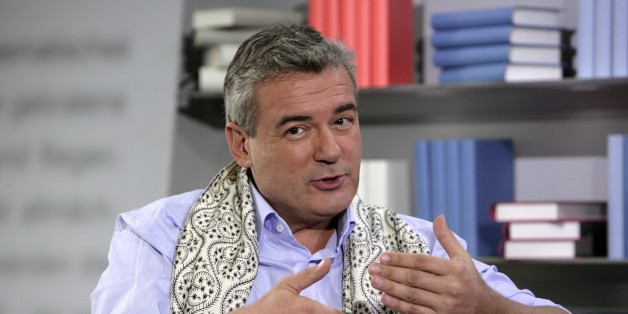
Ilija Trojanow
 
Get ready, America, and everywhere else where international readers of English-language novels dwell. U.S. translator Philip Boehm, with funding from the National Endowment for the Arts and the Goethe-Institut, which is funded by the German Ministry of Foreign Affairs, has completed a sizzling translation of an important ''cli-fi'' novel from Germany, titled ''EIS TAU'' in GERMAN in 2011 (for literally, ''ICE THAW,'' but rendered in the English version in 2016 as ''THE LAMENTATIONS OF ZENO,'' Zeno being Herr Zeno  Hintermeier, the main character in the novel.
 
Awareness of the emerging ''Cli-Fi'' genre has been growing by leaps and bounds in the English-speaking world ever since Angela Evancie reported on several modern cli-fi novels in an April 2013 NPR radio segment that went viral worldwide and secured a place for cli-fi in the annals of world literature.

And not only in English has the cli-fi term found a place in newspaper articles and book reviews (and blogs and tweets and pins on Pinterest) but the term has also found a home in non-English languages such as Finnish, German, French, Norwegian, Japanese, Chinese and Spanish.

Some non-English cli-fi novelists to jot down in your notebooks include: Jean-Marc Ligny and Yann Quero in France; Jesper Weithz in Sweden; Antti Tuomainen (''The Healer'' is in English now) and Emmi Itaranta ("Memory of Water" is in English now) in Finland; Bruno Arpaia in Italy; ''Anna'' by Jostein Gaarder and Gert Nygårdhaug's novel ''Chimera'' in Norway.
 
You want cli-fi? I'll will give you cli-fi.
 
Trojanow's novel is worth discovering and even if you don't know a word of German, the splended and smooth translation into polished English will introduce you to how German literature and culture is reacting to global warming and climate change.

Incidentally, you can read more about the book at the NEA website -- they were good enough to support the translation and deserve a big round of applause for doing so. (See "Writers' Corner" or the translation fellowship page at the NEA website.)

NOTE: The book's due out in May: Ilija and Philip will give a reading together on April 25
in St. Louis..
 
The translation of the novel was supported in part by a grant from the Goethe-Institut, which is funded by the German Ministry of Foreign Affairs, and by an award from the National Endowment for the Arts.
 
First published in English in May by Verso 2016 Translation © Philip Boehm 2016 First published as ''EisTau'' © Carl Hanser Verlag 2011
 

I don't think I will be giving anything away about the plot of the novel by noting here that Mr. Boehm, in his ''Author's Note'' at the beginning of the book, tells readers, well, let me tell you what he tells us, in a short excerpt from his note:
 
"With ''The Lamentations of Zeno,'' Ilija Trojanow charts new territory in prose as well as geography.
 
 ''[While] not a native speaker of German [since he was born in Bulgaria and later immigrated to Germany], Trojanow has adopted German and adapted it to his own purposes, taking full advantage of its lexical fecundity, creating words at will, and of its suspended syntax, with which he unleashes whole currents of consciousness.
 
''Alternating painterly descriptions of the natural world with cacophonic passages composed of song snippets, adspeak and “breaking news,” he contrasts the majestic stillness of the Antarctic with the clamor of human “civilization.”
 
''And all of this is framed within a confessional log that allows the reader to reconstruct the emotional course of the troubled protagonist. The sheer range of registers is impressive — and quite a challenge for the translator.
 
''The title itself is a case in point: A literal “IceThaw” not only lacks the “aura” of the original EisTau, it also fails to convey the layers of  meaning lurking in the German. “Melting Ice” seemed a bit lackluster, while “Meltdown” was more appropriate for any number of TV movies.
 
''......My primary task in translating the book [was] to recreate the voice of  Zeno Hintermeier — his gruff demeanor, deprecating self-irony, bone-dry wit, and great erudition. ......" 


At the end of the book in both its German and its English iterations, Mr Trojanow listed some of the people who guided him along the way as his novel took shape, noting:
 
''Thanks to everyone who generously shared their expertise and who helped me, on land as well as at sea:
 
Dr. Reinhard Böhm for the lively glacier tutorial
 
Kristina Dörlitz for the excellent research assistance
 
Alexandra Föderl-Schmid for the second commission
 
Petra Glardon for the wonderful iceberg photos
 
Prof. Dr. Wilfried Haeberli for his edifying encouragement
 
Christoph Hofbauer for his high-powered advice
 
Mijnheer Hans Huyssen for the music
 
Angelika Klammer for her inspired and inspiring editing
 
Freddy Langer for the friendly press service
 
Dr. Rudi Mair for the conversation about Alpine climate and Antarctic overwintering
 
Borrego Pedro Rosa Mendes for the days and nights at the Tejo Compañero
 
José F. A. Oliver for his empathetic reading of the manuscript
 
Papa Heinz Renk for showing me the Tyrolean glaciers
 
Dr. Miguel Rubio-Godoy for the avalanche of calamities
 
Dr. Christine Scholten for the medical review
 
Dorothée Stöbener for the first commission
 
Susann Urban for the gift of the title
 
Juli Zeh for the wielding the red pen
 
Hurtigruten Shipping for their double hospitality
 
The poems cited in my text are by Samuel Taylor Coleridge, Klabund and Pablo Neruda.''

-- Ilija Trojanow
 
Now .......for the novel itself. In fact, I am reading it now as I key-in these initial thoughts, and I feel that this ''cli-fi'' from Germany will take the English-speaking world by storm (no pun intended) and wake up more people worldwide to the very real issues of man-man global warming and climate change....not with government charts and boring statistics, but with an emotional roller-coaster ride from a master of modern German literature.
 
Welcome to America, Herr Trojanow! You are in very good hands with Mr Boehm as your able translator!
 
Cover von von Ilija Trojanows „Eis Tau“; © Hanser Verlag


BRIEF SYNOPSIS: In Ilija Torjanow’s climate-change cli-fi novel ''The Lamentations of Zeno''   -- first published in German in 2011 as Eis Tau -- humans are explicitly held responsible for climate change. This time, however, the accuser is one of them: Zeno Hintermeier, the novel’s protagonist, is convinced that humankind will destroy everything “that places itself on nature’s side”.
 
As a glaciologist and the leader of cruise ship exhibitions in the Antarctic, he becomes a key witness to the environmental destruction that goes hand in hand with technological progress exploited for tourism: the Antarctic, formerly a desolate continent of courageous explorers, can suddenly be “conquered” even by old-age pensioners thanks to modern ships.

 In ''The Lamentations of Zeno,'' Zeno’s elegiac grief at the melting of the poles serves not only to give greater emphasis to the “inconvenient truth”; it also serves as the basis for a more general criticism of human ignorance about climate change, the destructive power of which is embodied in particular by the tourists on board the cruise ship. Zeno condemns this through an act of self-administered justice ........ but I won't give away the SPOILER ALERT here just yet. Y[ou will have to read the book to find out  just what the author has in store for you.]
 
 
Ilija Trojanow's German-language cli-fi novel  'EisTau' (literally ''Ice Thaw'') has been translated now by Philip Boehm for VERSO BOOKS for MAY 2016 debut in English

''The Lamentations of Zeno'' -----(actually they are the lamentations of the novel's main character Mr. Zeno Hintermeier)
 
ORIGINAL TITLE in GERMAN is ''EIS TAU'' (literally ''ICE THAW'')

A Cli-Fi Novel By Ilija Trojanow, [a German-Bulgarian novelist, writing in German]

Now Translated in English by Philip Boehm in USA
(for this cli-fi novel coming out in May 2016 from VERSO Books
)

It's also a kind of travelogue: Ilija Trojanow has written many travel books as well as fiction.


A professor friend who knows German literature from A to Z tells this blog in a midnight email:You want to know about cli fi novels in German?

''Well, Ilija Trojanow's novel 'EisTau' is probably the best known German novel on climate change.''


A ''cli-fi'' about climate disaster and a scientist imploding on a journey to the Antarctic

WHAT SOME LITERARY CRITICS ARE SAYING:

''With 'The Lamentations of Zeno,' superbly translated by Philip Boehm, readers in America now have at their disposal a bird's eye view of German cli-fi, a novel so delicious yet prophetic that the world of German literature will never be seen in quite the same light again. Ilija Trojanow has hit a home run!" -- Dan Bloom, editor, The Cli-Fi Report

“There is little that a novelist can tell us on the subject that we do not already know, but Trojanow gives the statistics and prognoses a human dimension … one of Europe’s most original contemporary writers.” – UK Times Literary Supplement

“The Lamentations of Zeno is electric, irresistible, well written and movingly topical cli-fi. Ilija Trojanow, with several masterpieces to his name, never puts a foot wrong. He is as important a writer in this day and age as Günter Grass was for his—a joy to read.” – Nuruddin Farah, author of Hiding in Plain Sight

“Thrilling, nuanced, and chillingly meditative … Ilija Trojanow has written a modern cli-fi fable tinged with absurd humor, dramatizing the high stakes of our current climate gamble.” – Colum McCann, author of Let the Great World Spin


Cover von von Ilija Trojanows „Eis Tau“; © Hanser Verlag


EXCERPTS from CHAPTER ONE:

54°49´1˝ S, 68°19´5˝ W

There’s no worse nightmare than no longer being able to save yourself by waking up. Whenever we set sail from Ushuaia, we gather the evening before in one of the local dives that’s a little ways uphill and off the main streets, just when the last band of light is slipping from the sky. We haven’t seen one another for half a year, so we’re in the mood to celebrate as we crowd around a long wooden table.

The man waiting on us is old, and judging by his face not very adventurous, although at one parting he confessed to me that he was getting along well apart from an occasional urge to puncture his hand with a knife.

His place doesn’t have much on offer, but he’ll fill your glass for very little and I’m content to sit here holding my drink, surrounded by the hardworking Filipinos that make up most of the crew, now smiling broadly at our reunion.

Every payday brings them closer to settling down to a home and the sheltering shade of a large family, and so they soldier on, slogging through their working days with an astounding ease. For me they will always be an enigma.

Ushuaia is incapable of dampening their mood, as is any echo of the butchery, any painful reminder of the past—their ears are simply not tuned to that frequency, that legacy belongs to Europeans, those are the scars of the white man. They drift through this place just as they do through all the other places that have been defi led, all our ports of call (what a pretentious phrase from some liturgy of advertising), seeming not to touch the ground when they go ashore.

That is what separates us, we have no common past: what paralyzes me seems to fill them with life. Apart from that, they’re “easy to handle,” as our onboard hotel manager never tires of repeating (by which he means: much better than the unruly Chinese), as if he had personally trained them to be so diligent so patient so tame.

The Filipinos’ zeal would bother me were it not for Paulina, who at this moment is probably busy giving a personal touch to our shared cabin, equipping it with artifi cial fl owers and photographs depicting an entire menagerie of relatives—the numerous grandmothers perched in front on dilapidated rattan armchairs dragged into the garden just for the occasion, and standing behind them all the daughters and sons, loyal to a man except for the one who ran off and is rumored to be chopping vegetables in a New York restaurant.

I raise my glass to Paulina’s countrymen — mechanics, cooks, pilots — and to Ricardo, our dining room manager, as unobtrusive as a
shrink-wrapped suitcase, but watch out, his true power will be revealed during the course of the trip, every passenger will get to know him and a few will appreciate him (“Howzit going, Mr. Iceberger?” he says, giving me a thumbs-up, always concerned to clear potential misunderstandings out of the way before they happen).

It’s a sight for the gods, the way the millionaires from the northern hemisphere line up in front of his desk, eagerly bowing as they slip him an envelope to thank him for the coveted starboard table with a box-seat view of ice fl oes and leopard seals. My recent years at sea have taught me that rich people are prepared to pay considerable sums for little privileges. That sets them apart from the masses, feeds Ricardo’s confi dence, and fi nances the expansion of his guesthouse in Romblon.

 He’s no more interested in fur seals, leopard seals or penguins than he is in glaciers or icebergs, but he takes advantage of every scenic opportunity—“What a view, fantastic, fantastic, please take your seats,”—as he parades his teeth in a broad grin.

I’m sure he’d squeeze in just as many “fantastics” in front of a garbage depot as long as there were people willing to pay for a premium seat. All he really cares about is whether something is sellable or not. Whenever we’re all together he fl irts with the blonde whale lady now sitting to his left, always resorting to the same lines, which he polishes like a fi ngernail, “You know some day I’m going to sit in on your lecture, I mean it, I really want to learn all about these fi sh, now that I’ve watched them from the restaurant and seen them spouting, they really are very beautiful creatures” — but when it comes to the beautiful Beate, he has a hard time understanding why she prefers whales to people, which is why he’s going to sit in the fi rst row during one of her next lectures and write down every single word she says.

He promises this before every trip, when we’re gathered at the long wooden table that’s pitted and scored with random dents and notches. “This time I mean it,” he says, “I swear to heaven”—and the whale lady pinches his arm.

She speaks English with a German accent, German with a hint of Spanish, and Spanish with Chilean intonation. Despite his assurances, nothing will come of Ricardo’s “cetacean education.” But what he will do for certain at the end of the trip is pass a chef’s hat around on behalf of the men in the kitchen, while they line up in front of the curved buffet and perform a song in Tagalog that sounds like the ‘‘Hymn to the Unknown Server’’ and is always received with thunderous applause.

This blogger says: THAT EXCERPT FROM THE OPENING CHAPTERS IS JUST TO WHET YOUR APPETITE! ''BON APPETIT!''


see also: THE Cli-Fi Report's COUNTRY REPORT for Germany:
http://pcillu101.blogspot.tw/2015/06/cli-fi-country-reports-cli-fi-in.html

Cli-Fi in GERMANY:

Mr Trojanow was born in Sofia, Bulgaria in 1965. In 1971 his family fled Bulgaria through Yugoslavia and Italy to Germany, where they received political asylum. In 1972 the family travelled on to Kenya, where Ilija's father had obtained a job as engineer. With one interruption from 1977–1981, Ilija Trojanow lived in Nairobi until 1984, and attended a German-language school. After a stay in Paris, he studied law and ethnology at Munich University from 1985 to 1989. He interrupted these studies to found Kyrill-und-Method-Verlag in 1989, and after that Marino-Verlag in 1992, both of which specialised in African literature. In 1999 Trojanow moved to Mumbai and became intensely involved with Indian life and culture. He has lived in Cape Town, returned to Germany (Mainz), and then to Austria, where he currently resides in Vienna.

In the 1990s Trojanow wrote several non-fiction and travel books about Africa, published an anthology of contemporary African literature and translated African authors into German. His first novel, "Die Welt ist groß und Rettung lauert überall", appeared in 1996. In it he recounts his family's experiences as political refugees and asylum seekers. After that appeared the science fiction novel "Autopol", created on the Internet as a "novel in progress," "Hundezeiten", a travel account of a visit to his Bulgarian homeland, and books dealing with his experiences in India. His reportage "Zu den heiligen Quellen des Islam" describes a pilgrimage to Mecca.

Since 2002 Ilija Trojanow has been member of the PEN centre of the Federal Republic of Germany. Among other awards he received the Bertelsmann Literature Prize at the Ingeborg Bachmann competition in Klagenfurt in 1995, the Marburg Literature Prize in 1996, the Thomas Valentin Prize in 1997, the Adelbert von Chamisso Prize in 2000 and the Leipzig Book Fair Prize in the category of fiction for his novel "Der Weltensammler" (The Collector of Worlds) in 2006.