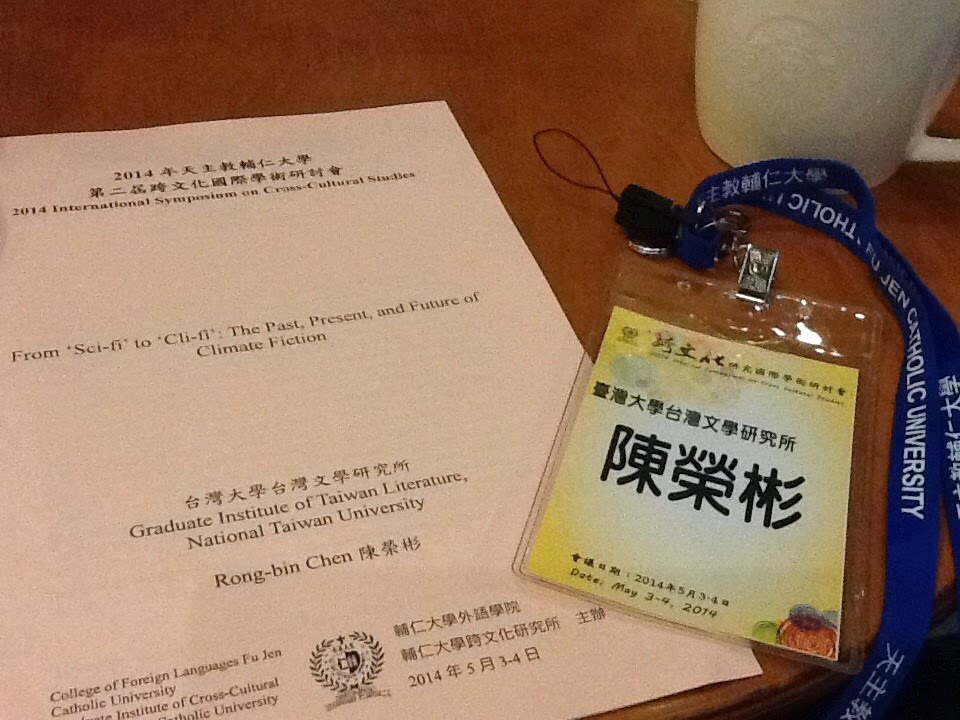
From Sci-fi to “Cli-fi”:
The Past, Present, and Future of
Climate Fiction
Presented by Richard Rong-bin Chen (陳榮彬)
National Taiwan University (NTU) - Taipei
Adjunct Assistant Professor, Graduate Institute of Taiwan Literature, National Taiwan University
Abstract
Ever since the birth of the term “cli-fi”
on the internet, it has been a much debated sub-genre of sci-fi. One of the
controversies surround it is that whether “cli-fi,” a term coined by the
American freelance journalist Dan Bloom in 2008, is redundant when we already
have sci-fi, which is supposed to deal with the relationship between science
and fiction as a literary genre. As a preliminary academic study on “cli-fi,”
this essay tries to perform a three-fold task. First, it will try to review the
not-so-faraway history of cli-fi, whose origin might be traced back to The Drowned World (1962), the second
novel by J.G. Ballard, the renowned British sci-fi writer. Second, the essay
aims at demarcating the line between cli-fi and traditional works of sci-fi:
that is, while the former is usually filled with apocalyptic and moral
implications of climate catastrophes, the latter with the intention of
exploring the possibilities of science and its relationship with mankind.
Climate fiction is not only about global warming, but also a “global warning”
which can send messages to as many people as possible. Third, the essay argues
that the present situation of cli-fi shows the fact it has gone beyond the
reach of genre fiction, and touched upon the more serious and philosophical
issues such as the problem of “posthumanity.” With the participation of writers
such as Ian McEwan and Margaret Atwood in the discussion of cli-fi, the future
of this genre surely has abundant possibilities and more writers will be
attracted to write and more readers attracted to read works of cli-fi.
Keywords:
Science Fiction, Climate Fiction, Cli-Fi, Climate Change, Climate Catastrophes,
Posthumanity
*Adjunct Assistant Professor,
Graduate Institute of Taiwan Literature, National Taiwan University
Introduction
When I first started to write this essay in
May of 2013, the Moore tornado had just struck Oklahoma, killing at
least 24 people and injuring 377 others. The catastrophic large-scale tornado
had a film-like nature which easily evoked people of scenes in bestselling
movies such as the disaster drama and sci-fi movie Twister (1996), which coincidentally set in Oklahoma. I think the
growing frequency of this type of climatic disasters is obviously one of the
reasons why the so-called “cli-fi” novels have in recent times caught much more
attention from both readers and critics alike than in the past.
Ever since the advent
of the term “cli-fi” on the Internet, it has been a much debated sub-genre of
sci-fi. One of the controversies surrounding it is that whether “cli-fi,” a
term coined by the American freelance journalist Dan Bloom in 2008, is redundant
when we already have sci-fi, which is supposed to deal with the relationship
between science and fiction as a literary genre. As a preliminary academic
study on “cli-fi,” this essay will begin with a review of the not-so-faraway
history of cli-fi, whose origin might be traced back to The Drown World (1962), the second novel by J.G. Ballard
(1930-2009), the renowned British sci-fi writer.
In the latter parts of
this essay, two more issues will be brought forth to be discussed in a more
detailed fashion. First, how should “cli-fi” be studied in the academic world
in the future? Actually this question essentially is dealing with the
relationship between “cli-fi” and “sci-fi,” and it is also about whether we
should continue to view the former as a newer part of the latter. Furthermore,
what are some of the socio-political and even philosophical messages implied in
some of the representative works of cli-fi in the recent years? What stances on
the problem of “climate change” do the writers take by writing the works?
The
Rising of “Cli-fi”: From the Past to Present
The relationship between climate (and climate
change) and literature can be as old as the Bible, which provides us with the
famous “Noah’s Ark” story depicting how a family survived an eschatological
flood. Almost 20 years ago, this specific literary relationship has been dealt
with in Climate and Literature:
Reflection of Environment (1995), a Texas Tech University Press comparative
literature academic anthology edited by Janet Pérez, which in majority focuses
on literary works of fiction from Central and Southern America.
In spring of 2003, Granta, a renowned London-based British literary
quarterly established in 1889, published a special issue entitled This Overheating World which obviously
deals with the “global warming” problem which concerns many people around the
world from a literary perspective. Both This
Overheating World and Climate and
Literature can be seen as a part of the “pre-history” of cli-fi, since the
coinage of this literary term would not be possible until 2008.
Dan Bloom, a
Taiwan-based freelance journalist and writer from Boston, was involved in
publicizing Polar City Red (2007), a
cli-fi novel written by Jim Laughter which is set in Alaska in 2075,
when he came up with the “cli-fi,” a term which obvious is the combination of “climate
change” and “fiction” and easily evokes readers of “sci-fi,” which, in turn, is
the combination of “science” and “fiction.”
The term “cli-fi” had existed
without due public attention until a series of articles were published in 2013
and heated up its popularity among both readers and critics.
For example, Rodge Glass, a British novelist and university
lecturer, contributed an article entitle “Global Warning: The Rise of ‘Cli-fi’”
for The Guardian, one of the
mainstream British newspapers, writing in a welcoming tone that whenever a
literary term “gains traction it is a chance to examine not only what it says
about the writers who explore the new ground but also the readers who buy it,
read it, discuss it” (Glass). Actually, before this piece got published, we
also saw Husna Haq, a female correspondent of The Christian Science Monitor, wrote a coverage article entitled “Climate
Change Inspires a New Literary Genre: Cli-fi” in April 2013.
When talking about the rising of “cli-fi” in the literary world, three
more points are worth emphasizing. First should be the publication of
collections of “cli-fi” stories. Three years after the term had been created,
Gordon Van Gelder, a famous American science fiction magazine editor, collected
and edited more than a dozen stories for an anthology entitled Welcome to the Greenhouse: New Science
Fiction on Climate Change (2011). As Van Gelder writes in the introduction
of the book, he asked contributors to provide their perspectives on the problem
of climate change, and the answers revealed in the stories are both pessimistic
and optimistic, and most of the stories posed further problems rather than just
giving answers. In the same year, a similar effort was made by Verso, one of
the mainstream British publication houses: writer Toby Litt edited for the
company I’m With the Bears: Short Stories
From a Damaged Planet (2011), a story collection with environmentalist
stories written by award-winning novelists such as Margaret Atwood, David
Mitchell, and T. C. Boyle.
In the same manner, Tony Bradman, a senior British children’s book
writer, was responsible for the publication of Under the Weather: Stories about Climate Change (2012), a volume,
as Bradman explains in the introduction, consists of stories set in a wide
range of localities from Siberia and Canada to Australia, UK, Sri Lanka and the
Philippines. Another British project came up the next year with the
environmentalist novelist Gregory Norminton editing the story collection Beacons: Stories for Our Not So Distant
Future (2013), whose contributing novelists donated all their royalties to Stop
Climate Chaos Coalition, the UK’s largest group of people dedicated to action
on climate change and limiting its impact on the world’s poorest people.
The second place where we can see the booming of “cli-fi” is the
universities providing “cli-fi” courses. For example, in the U.K. in June 2014,
Institute of Continuing Education, Oxford University will provide a 5-day
Literature Summer School course named Cli-fi?
Climate Change and Contemporary Fiction, with lecturer Jenny Bavidge as its
course director.
In winter 2014, a more formal course will be provided in Department of English,
the University of Oregon in Eugene by Professor Stephanie LeMenager. Her
course, The Cultures of Climate Change,
will be one of the graduate seminars provided by the department, which, besides
discussing interdisciplinary academic works, focuses on works of cli-fi by Nathaniel
Rich.
When the “cli-fi” articles appeared in newspapers like The Guardian and The Christian Science Monitor in April and May, 2013, many debut
writers, either coincidentally or uncoincidentally, published their first
novels, which are unanimously about climatic catastrophes. For example, in Riders of the Wind (2013) by Lee Penny,
we can see Tokyo almost destroyed by hurricanes, and in Summer Reign (2013) by G. Thomas Hedlund and Water’s Edge (2013) by Rachel Meehan, we can see the world plagued
by abnormal and extreme climatic conditions such as floods, heat waves, storms,
and draughts. This also shows a growing interest among the new-generation
writers in writing works of “cli-fi.”
“Cli-fi” and Its Implications
As a preliminary study
on “cli-fi,” one of the things to be done in this essay is an attempt to
demarcate the line between cli-fi and traditional works of sci-fi. According to
one of the exemplary definitions of science fiction provided by The Harper Handbook to Literature, it is
a genre of fiction “in which new and futuristic scientific developments propel
the plot” (418). While the definition is simple enough, it states something
obviously clear: the point of science fiction is always about exploring the
possibilities of scientific developments and its relationship with mankind.
Works of “cli-fi” can be very different from
sci-fi in this aspect. Although readers might be exposed to many meteorological
and scientific details in cli-fi stories and novels, what strike them as more
impressive and astonishing are usually the apocalyptic and moral implications
of climate catastrophes. For example, in The
Rapture (2009), a thriller written by British novelist Liz Jensen, we can
see a world plagued by the problem of melting temperatures and tornadoes,
hurricanes, and earthquakes destroyed cities like Rio de Janeiro and Istanbul.
While these plot elements might sound surreal in the past, their verisimilitude
has been greatly enhanced by Hurricane Katrina, the deadly Atlantic tropical
cyclone which almost wiped out the American city of New Orleans in 2005.
Fictional natural disasters seem real enough in this post-Katrina era of
climate change.
Another work of cli-fi
Odds against Tomorrow (2013) can be
read as a novel with a thrilling sense of reality. Not very long after the
Katrina disaster, its author Nathaniel Rich moved to New Orleans and started to
write Odds against Tomorrow, a novel
set in Rich’s hometown New York City and written about a great flood which
almost devours the whole city. Weird enough, just before the publication of the
novel, Hurricane Sandy hit the city, causing a power plant explosion and great
flood in Manhattan. In the end, it cost the city 148 lives and more than 68
billion dollars. For the New Yorkers, the illustration on the book cover cannot
be more painfully evocative: famous skyscrapers such as the Empire Building
were drowned in a water world. Actually, this motif of a world drowned in flood
dates back to more than 40 years before the advent of the term “cli-fi.” According
to many critics, the first “cli-fi” novel ever written should be The Drowned World (1962) by J. G.
Ballard, one of the masters of British contemporary science fiction writer,
which depicts a world almost drown in water after the melting of polar ice-caps
caused by solar radiation.
To borrow the phrase
used by Rodge Glass in his aforementioned The
Guardian article, climate fiction is not only about global warming, but
also a “global warning” which can send messages to as many people as possible.
Also, just like Gregory Norminton argues in the introduction of Beacons: Stories for
Our Not So Distant Future,
the story collection he edited: “Global warming is a predicament, not a story.
Narrative only comes in our response to that predicament.” In other words, for
Norminton, writing “cli-fi” carries an extra responsibility of obeying the “moral
imperative” of hope (viii-ix). “Cli-fi” differs greatly from sci-fi in the fact
that, while both of them focus on exploring scientific possibilities, “cli-fi”
actually is dealing with possible apocalyptic catastrophes which novelists feel
that they might and should help to reveal to the whole world in order to
prevent from happening. “Cli-fi” stories can do what scientific statistics
cannot: that is, motivating and persuading readers.
The Philosophical and Socio-political Aspects of “Cli-fi” Novels
One of the most imposing warnings that “cli-fi” novels can provide
is the problem of “post-humanity”: is mankind doomed to extinguish due to
climate change in the future? Is human nature going to change in possible
end-of-the-world scenes described in all kinds of religious and prophetic
writings? One novelist pay due attention to these problems in recent years is
obviously Margaret Atwood, the Canadian Booker Award winner who contributed one
story for the aforementioned anthology I’m
With the Bears: Short Stories From a Damaged Planet. Atwood used her “Oryx
and Crake” trilogy, which consists of Oryx
and Crake (2003), The Year of the
Flood (2009), and MaddAddam
(2013), to depict an imagined post-apocalyptic world caused by the technology
of cloning and a devastating “waterless flood.” Although the flood in The Year of the Flood is only
metaphoric, and actually it refers to a flood-like pandemic manmade plague
which almost wiped out mankind, detailed depictions of extreme climate
conditions, like higher radiation, warming sea water, droughts, and loss of
seasons, can be seen everywhere. If not a “cli-fi” novel in its most strict
sense, at least The Year of the Flood
can be seen as an environmentalist novel.
Michael Crichton’s techno-thriller novel State of Fear (2004) and Ian McEwan’s Solar (2010) deals with the negative and controversial issues about
the problem of climate change as a socio-political subject. In State of Fear, in order to promote the
threatening nature of global warming, a group of eco-terrorists and
environmental activists worked together to create a state of fear among the
general public. For the eco-terrorists, they wanted to save the earth at the
cost of a certain number of human lives sacrificed. And for the environmental
activists, they just wanted to perpetuate the funding they received due to the
social concern of global warming. What Crichton depicts in the novel is
actually the very thin line between environmental activism and a possible type
of terrorism founded on the basis of a fictitious pseudo-scientific theory of
climate change and global warming.
In McEwan’s Solar, the protagonist is the Nobel
Prize winner who stole the technology of artificial photosynthesis needed for
solar power plant from a deceased junior colleague. Toward the end of the
novel, he was just one step away from being the scientific hero who solved the
problem of global warming, but was found guilty of plagiarism. He was left with
multi-million debts after his business partner abandoned their power plant
project, and the panels of the plant vandalized by some unknown person. Though
the novels by Crichton and McEwan both look cynical and anti-environmentalist,
they can be seen as proofs of “cli-fi” as a genre with a self-reflexive nature,
which reminds us of how difficult it usually is to differentiate between what
is scientific and what is pseudo-scientific. While climate change can be
scientifically true to some extent, it will be an ideological tragedy to push
it to the extreme and leave no room for rational discussions.
The
Future of “Cli-fi”
In the 2003 spring
issue of Granta, one of the most
renowned British literary magazines, environmentalist Bill McKibben contributed
his article “Worried? Us?” for the special issue entitle This Overheating World and wrote that
Global Warming has
still to produce an Orwell or a Huxley, a Verne or a Wells, a Nineteen
Eighty-Four or a War of the Worlds, or in film any equivalent of On
the Beach or Doctor Strangelove. It may never do so. It may never do
so. It may be that because—fingers crossed—we have escaped our most recent
fear, nuclear annihilation via the Cold War, we resist being scared all over
again. (42)
This
argument seems to be wrong in at least two aspects. First, after J.G. Ballard
has been joined by masters like Atwood and McEwan to be included in the genre
of “cli-fi,” it looks highly probable that more and more classics of “cli-fi”
will be created in the future. Also, from the discussions so far in this essay,
obviously the fear McKibben mentions in the article should be either
non-existent or overcome long ago, since, from my previous analysis, “cli-fi”
has become a rising genre which is not merely a sub-genre of sci-fi.
To conclude the essay, it should be
stressed, three descriptive observations have been made above.
First, the
development of “cli-fi” so far takes the form of newspaper articles, story
collections, and just two university courses, so we hope more and more efforts
from the academic circles and publication houses can be made in the future.
Second, “cli-fi,” due to its responsibility of bringing climate change problems
to public attention, has a moral aspect of promoting an apocalyptic
world-vision which is not always present in sci-fi.
Third, the apocalyptic
vision of climate change and global warming problems is not always treated in a
de facto way: that is, at least we
can see some novelists, such as McEwan and Crichton, do not take this kind of
worldview for granted. For them, what is fictional is not only the genre, but
also the end of world the genre claims to avoid.
Works Cited
I
Primary Sources:
Atwood,
Margaret. The Year of the Flood.
London: Bloomsbury, 2009.
Ballard,
J. G. The Drowned World. New York:
Berkeley Books, 1962.
Bradman,
Tony. ed. Under the Weather: Stories about Climate Change. London: Frances Lincoln Children's Books, 2012.
Crichton,
Michael. State of Fear. New York:
HarperCollins, 2004.
Jenzen,
Liz. The Rapture. London: Bloomsbury,
2009.
Laughter,
Jim. Polar City Red. Deadly Niche
Press, 2012.
Litt,
Toby. ed. I’m With the Bears: Short Stories from a Damaged Planet. London: Verso, 2011.
McEwan,
Ian. Solar. New York: Random House,
2010.
Norminton,
Gregory. ed. Beacons: Stories for Our Not So Distant Future. London: Oneworld Publications, 2013.
Rich,
Nathaniel. Odds against Tomorrow. New
York: Picador, 2013.
Van
Gelder, Gordon. ed. Welcome to the Greenhouse: New Science Fiction on Climate Change. New York: OR Books, 2011.
II
Secondary Sources:
“Science Fiction.” The Harper
Handbook to Literature. Ed. Northrop Frye et al. New York: Harper, 1985. 418-9.
McKibben,
Bill. “Worried?
Us?”
Ideas, Insights and
Arguments: A Non-fiction Collection. Ed. Michael
Marland. Cambridge: Cambridge UP, 2012. 38-44.
Norminton,
Gregory. Introduction. Beacons: Stories for Our Not So Distant Future. Ed.
Gregory Norminton. London: Oneworld Publications,
2013. vii-ix.
Pérez,
Janet and Wendell M. Aycock, ed. Climate and
Literature: Reflection of Environment. Lubbock: Texas
Tech UP, 1995.
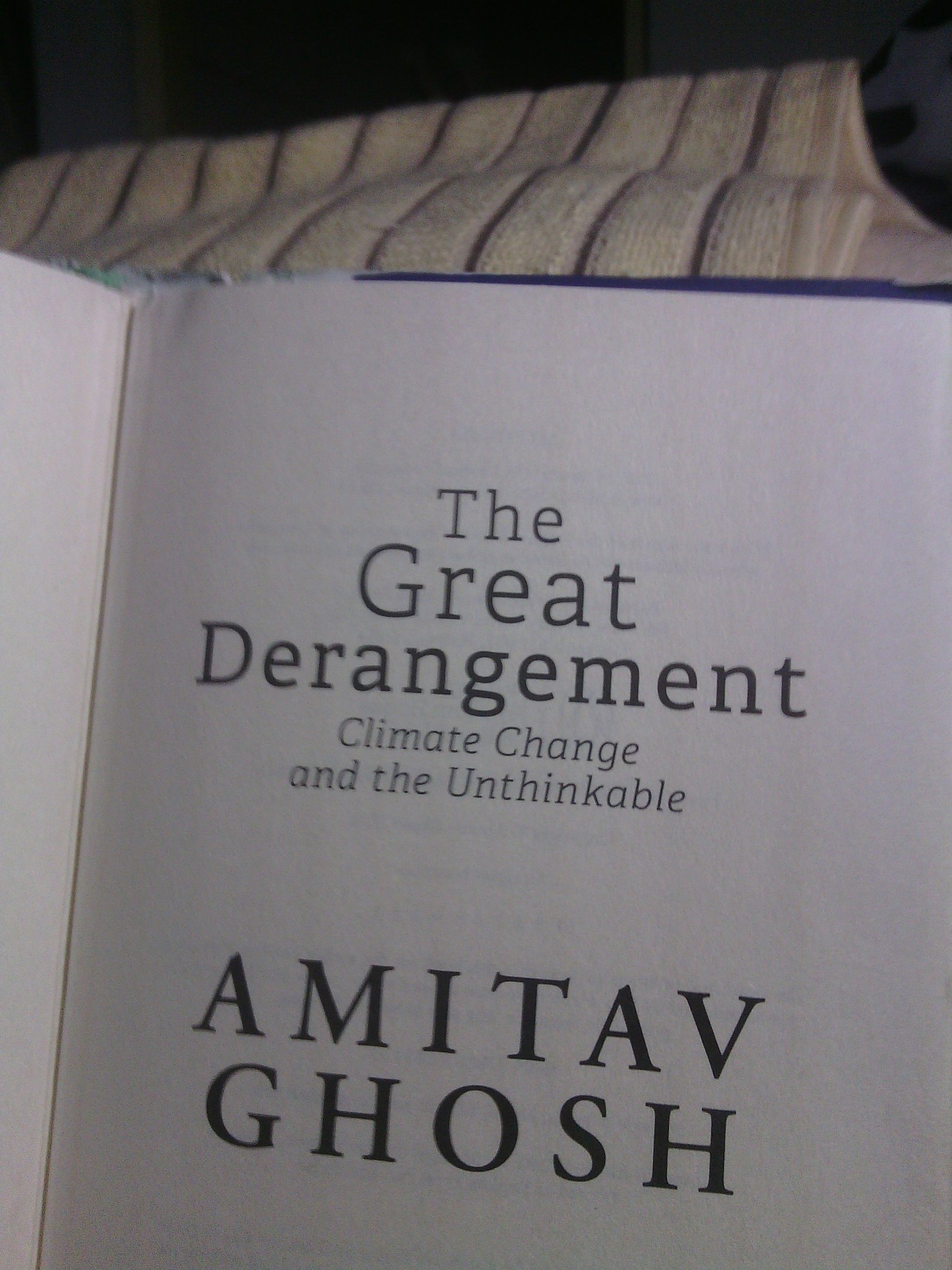


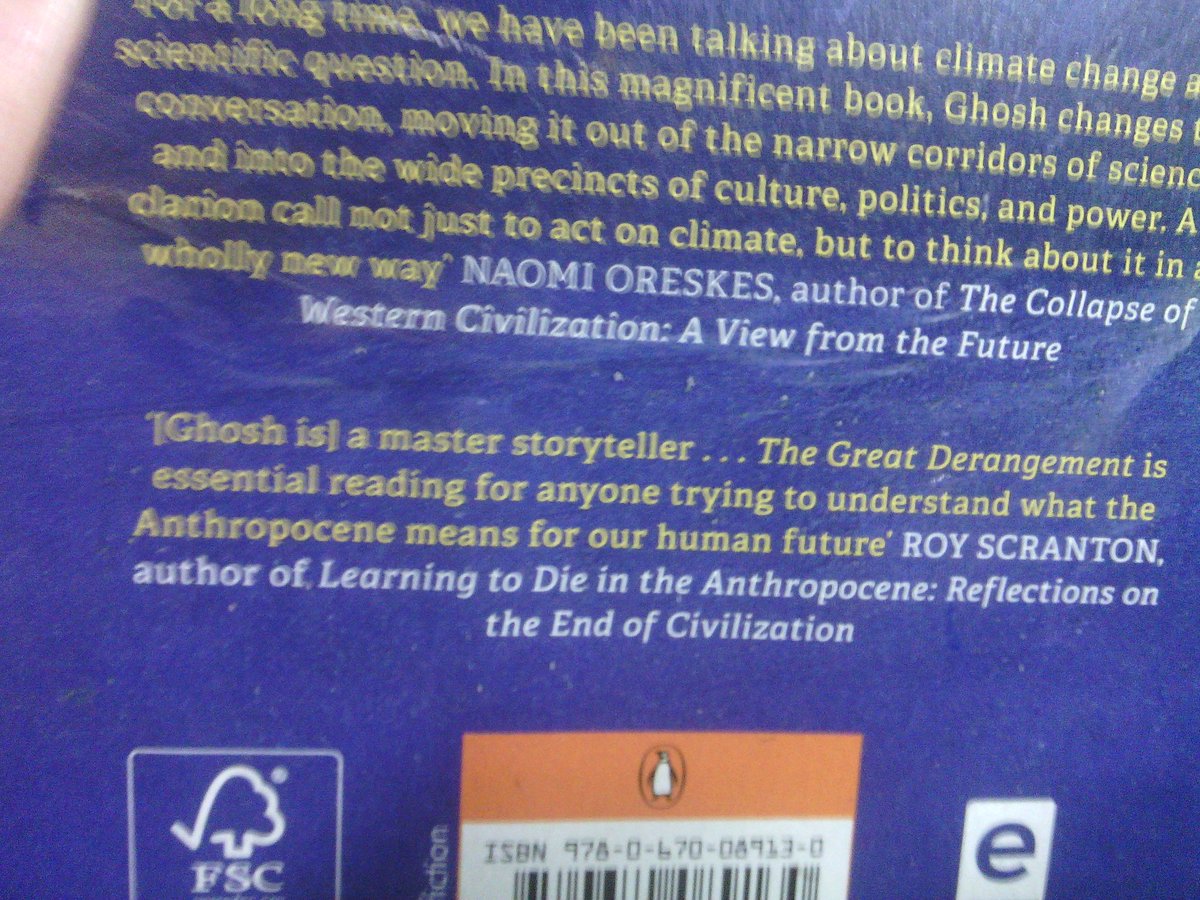
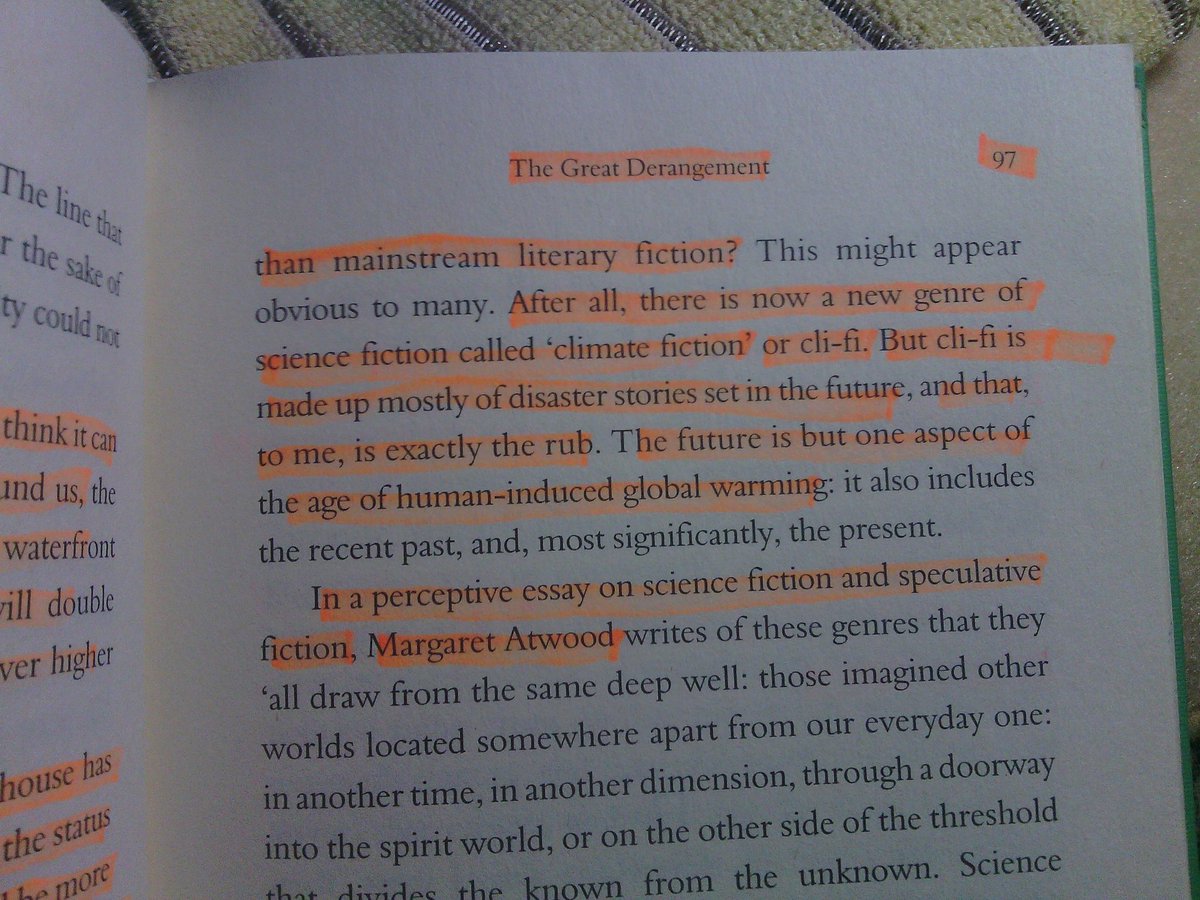

 Amitav Ghosh’s lyrical cli-fi novel The Hungry Tide, published in 2004, transported us to the magical world of the Sundarbans in Bengal, where nature is the chief protagonist, where the “non-human” elements of life must be recognised because they overwhelm you. Anyone who has read that book will not be surprised to witness the evolution of Ghosh’s reflections on the environment in The Great Awakening.